That gap between SaaS adoption and SaaS management creates real problems: wasted spend, security blind spots, compliance failures, and operational chaos. For organizations with distributed field teams — retail chains, bank branches, manufacturing plants — the challenge compounds further when frontline workers operate outside traditional IT oversight.
This guide covers everything you need to build a functioning SaaS operations management program: what it is, why it matters, its core pillars, how to build a strategy, what to look for in a tool, and best practices to sustain it long-term.
TL;DR: Key Takeaways
- SaaS operations management means digitizing, standardizing, and governing how work gets done across locations
- Unmanaged operations create compliance gaps, inconsistent execution, and zero visibility into field performance
- Cross-functional ownership — Operations, Compliance, IT, and Finance — is essential for it to work
- Strategy and process design come first; platforms and tools follow
- Organizations that digitize operations with structured workflows see faster audits, fewer errors, and measurable cost savings
What Is SaaS Operations Management?
SaaS operations management — often called SaaSOps — is the practice of systematically overseeing, optimizing, and governing all SaaS applications within an organization. It covers inventory, usage, costs, user access, and compliance, with the goal of ensuring software investments actually deliver operational value.
How SaaSOps Differs from Traditional IT Management
Traditional IT was built around on-premises infrastructure and centrally purchased perpetual licenses. SaaSOps addresses a fundamentally different reality: subscription-based, cloud-hosted software where any employee can sign up for a new tool without IT's knowledge or approval.
That decentralization creates real problems — shadow IT proliferates, costs fragment across departments, and no single team has full visibility into what's actually running in the environment.
Who Owns SaaSOps?
SaaSOps is not an IT-only concern. It spans:
- IT — governance policy, security vetting, integration standards
- Finance — spend tracking, budget allocation, ROI measurement
- Procurement — vendor contracts, renewal negotiations
- Legal — data processing agreements, compliance obligations
- Business unit leaders — app ownership, adoption accountability
Related disciplines — SaaS governance, software asset management (SAM), and application portfolio management — overlap significantly with SaaSOps. Each approaches the same underlying challenge: organizations are spending more on software than ever, with less clarity on what's being used, by whom, and whether it's worth the cost.
Why SaaS Operations Management Matters More Than Ever
The scale of the problem is significant. Zylo's 2025 SaaS Management Index reports average SaaS spend of $4,830 per employee, up 21.9% year-over-year. For large enterprises, that translates to $284M in annual SaaS spend — and the vast majority of organizations cannot account for all of it.
The Shadow IT Problem
Shadow IT — apps purchased outside IT's purview — is more widespread than most organizations realize. Zylo's 2024 research found that more than one-third of a company's applications are shadow IT, and 65% of employee-expensed apps had "Poor" or "Low" risk scores.
For distributed teams operating across retail stores, warehouses, or field sites, shadow IT risk is amplified. Employees adopt tools that solve immediate problems without considering security standards or data handling implications.
The Financial Cost of Inaction
License waste is the most visible and controllable cost leak in any SaaS portfolio:
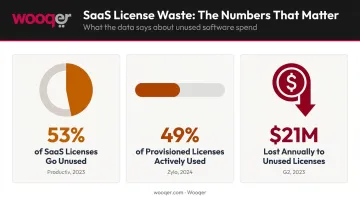
- 53% of SaaS licenses go unused, per Productiv's 2023 research
- Only 49% of provisioned licenses were actively being used, per Zylo's 2024 data
- The average enterprise loses $21M annually to unused licenses
Beyond waste, unmanaged SaaS creates redundant tools with overlapping functionality, missed renewal windows, over-licensed seats, and budget overruns that build up unnoticed across departments.
Compliance and Regulatory Exposure
For organizations in regulated industries — banking, pharma, healthcare, manufacturing — unmanaged SaaS directly threatens audit readiness. A SaaS vendor handling sensitive data without a reviewed data processing agreement is an unresolved compliance liability.
The average enterprise also faces nearly 211 SaaS renewals every year, according to Zylo. Without proactive governance, contracts auto-renew at unfavorable terms or lapse entirely — creating both financial and operational disruption.
The Core Pillars of SaaS Operations Management
Effective SaaSOps rests on four interconnected pillars. Managing them in isolation creates gaps; the value comes from treating them as a unified system.
Pillar 1: SaaS Discovery and Inventory Management
You cannot manage what you cannot see. Inventory management is the foundation — continuous discovery of every SaaS tool in use, including those purchased via credit cards or employee expense accounts.
Good inventory management captures:
- Application owner and sponsoring department
- Vendor name and contract terms
- Active user count vs. licensed seats
- Security certifications (SOC 2, ISO 27001, etc.)
- Subscription cost and renewal dates
- Data classification (does this app handle sensitive data?)
Pillar 2: License and Cost Optimization
License management tracks the full lifecycle of every SaaS seat — from provisioning during onboarding through deprovisioning when employees leave or change roles. The goal is to identify unused seats, eliminate redundant tools, and right-size subscriptions before renewal windows close.
This pillar has the clearest financial return. With more than half of all provisioned licenses sitting unused, most organizations have immediate savings available without cutting a single tool that teams actually rely on.
Pillar 3: User Lifecycle and Access Management
Access management governs how SaaS permissions are granted, modified, and revoked across the employee lifecycle. Ideally, this runs through role-based access control (RBAC) and automated workflows tied to HR events.
The offboarding gap is where most organizations have the highest exposure. BetterCloud's 2024 State of SaaSOps found that 50% of IT departments take more than 24 hours to complete tasks for departing users. Former employees or contractors retaining active SaaS access is one of the most common vectors for data leakage.
Effective user lifecycle management also means:
- Automating provisioning workflows triggered by HRIS onboarding events
- Adjusting access when employees change roles or departments
- Running quarterly access reviews to catch orphaned accounts
Pillar 4: Security, Compliance, and Renewal Governance
Security governance means vetting each SaaS tool against relevant standards (SOC 2, ISO 27001, GDPR, HIPAA) before it enters the approved portfolio, then monitoring continuously after. Every app that handles sensitive data should have a reviewed data processing agreement on file.
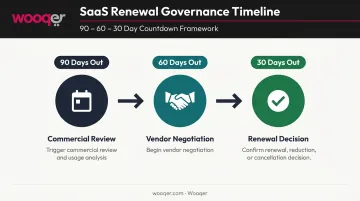
That compliance documentation also makes renewal reviews easier. When commercial terms are visible alongside security status, organizations can make informed decisions well before the deadline. A structured renewal calendar prevents auto-renewals at last year's pricing and last year's seat count:
- 90 days out: Trigger commercial review and usage analysis
- 60 days out: Begin vendor negotiation
- 30 days out: Confirm final decision on renewal, reduction, or cancellation
How to Build a SaaS Operations Management Strategy
Getting SaaS operations under control starts with structure — not software. These three steps lay the foundation.
Step 1: Establish a System of Record
Before anything else, create a single source of truth for all SaaS data — app ownership, spend, usage, and contract details. Spreadsheets fail here because they require manual updates and cannot capture the continuous, decentralized nature of modern SaaS procurement.
A centralized system of record should answer four questions at any moment:
- What apps do we have?
- Who owns each one?
- What are we paying?
- When do contracts renew?
Once that foundation exists, the next challenge is getting the right people involved.
Step 2: Align Cross-Functional Stakeholders
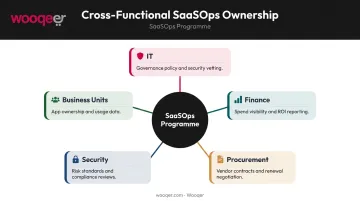
SaaSOps programs that live inside IT alone tend to stall. Cross-functional alignment is critical — with clear ownership across teams:
- IT owns governance policy and security vetting
- Finance owns spend visibility and ROI reporting
- Procurement owns vendor contracts and renewal negotiation
- Security enforces risk standards and compliance reviews
- Business unit leaders own their apps and usage data
Consider forming a SaaSOps task force with representatives from each function — even a monthly 30-minute sync creates more alignment than an annual review.
Alignment alone won't sustain the program. You need numbers that prove it's working.
Step 3: Define Measurable Success Metrics
SaaSOps programs earn executive sponsorship when they connect to strategic outcomes. Define metrics before you start:
- Percentage reduction in unused licenses
- Number of apps with completed security reviews
- Renewal negotiation savings vs. previous year
- Onboarding and offboarding cycle time
- Percentage of shadow IT identified and remediated
Tie these to business objectives — cost reduction, compliance readiness, operational efficiency — and report on them quarterly. With metrics in place, the focus shifts to choosing the right tools to execute against each one.
Choosing the Right SaaS Operations Management Tool
Core Capabilities to Evaluate
When selecting a SaaSOps platform, look for these capabilities as a baseline:
- Automated app discovery — including shadow IT detected through expense feeds and SSO logs
- Usage analytics at the user, department, and location level
- License management with right-sizing recommendations ahead of renewals
- Role-based access workflows tied to HR events
- Compliance reporting with audit-ready documentation
- Renewal tracking with proactive alerts at 90, 60, and 30-day thresholds
- HR and identity system integration for automated provisioning and deprovisioning
Gartner defines SaaS Management Platforms as tools that discover, manage, optimise and automate the SaaS application lifecycle from a centralized console — that framing is a useful evaluation checklist. That framing holds up well as a baseline — but for field-heavy organizations, it only covers half the picture.
The Field Operations Dimension
For organizations with distributed teams — retail stores, QSR locations, bank branches, manufacturing plants, warehouses — SaaS operations management cannot stop at the back office. Frontline workers interact with operational software daily, often in environments with intermittent connectivity and no direct IT support.
Platforms built for this context — such as Wooqer — extend operational management to the front line through mobile-first WorkApps that function offline, capture geo-tagged photo evidence, and support role-based access across hundreds of locations. For regulated industries, audit readiness matters at the point of work, not just in the back office: compliance WorkApps that generate timestamped, PDF-ready reports are a practical necessity, not a nice-to-have.
Pricing structure matters here too. Per-seat models become prohibitively expensive when scaling to thousands of field users. A flat or unlimited-user model removes that barrier and lets organizations deploy without rationing access.
Avoiding the Over-Tooling Trap
The best SaaSOps tool is the one teams actually use. Evaluate platforms on:
- Deployment speed — days to go live vs. months-long implementations
- Offline capability — critical for field teams in low-connectivity environments
- User adoption mechanics — role-specific training, mobile-first design, intuitive interfaces
- Scalability without cost penalties — unlimited users vs. per-seat pricing that punishes growth
Shelf-ware is its own form of SaaS waste. A platform that requires six months of professional services before going live isn't a solution — it's a delayed liability.
Best Practices for SaaS Operations Management
The most mature SaaSOps programs measure software ROI, track adoption rates, and retire tools that no longer serve their original purpose. Software is a business investment — not an IT expense line.
Manual processes across every lifecycle stage are error-prone by design. Automating them reduces both administrative burden and risk:
- Onboarding and offboarding: Policy-based RBAC triggers provision and revoke access automatically
- Renewal tracking: Calendar alerts prevent surprise auto-renewals and budget overruns
- Compliance checks: Automated audit trails remove the need for manual reconciliation
Not every app needs the same level of scrutiny. Tiering your governance by risk and impact keeps oversight proportionate:
| Tier | App Type | Governance Approach |
|---|---|---|
| Tier 1 | Enterprise tools (CRM, ERP, HRIS) | Deep oversight, quarterly reviews, full security vetting |
| Tier 2 | Departmental tools | Semi-annual reviews, usage monitoring, renewal alerts |
| Tier 3 | Low-cost, low-risk tools | Automated alerts, annual check-in |
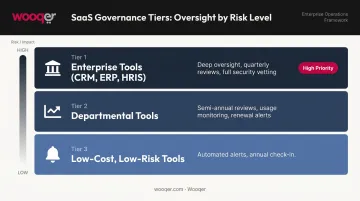
This model keeps the program sustainable without overwhelming the teams responsible for it.
Shadow IT fits naturally into this framework. Build a quarterly process for surfacing expensed SaaS applications and running them through a rapid security review. Most shadow IT isn't malicious — it's employees solving real problems with available tools. A light-touch approval workflow is more effective than blanket prohibition.
Frequently Asked Questions
What is SaaS operations management software?
SaaS operations management software is a centralized platform that helps IT, Procurement, and Finance teams discover, monitor, and optimise all SaaS applications within an organization. It covers license usage, security compliance, user access, and renewal tracking from a single dashboard.
What does a SaaS operations manager do?
A SaaS operations manager oversees the full lifecycle of an organization's software portfolio, spanning procurement, license optimization, security governance, and renewal negotiation. The role serves as the connective tissue between IT, Finance, and business units on all software decisions.
What are the key components of SaaS operations management?
The four core pillars are: app discovery and inventory management, license and cost optimization, user lifecycle and access management, and security, compliance, and renewal governance.
How is SaaSOps different from traditional IT management?
Traditional IT management was built for on-premises, centrally purchased software. SaaSOps addresses decentralized SaaS subscriptions where anyone in the organization can buy software independently — creating visibility, cost, and compliance challenges that legacy IT tools were never designed to handle.
What are the biggest challenges in SaaS operations management?
Shadow IT, license waste from unused seats, missed auto-renewals, and security compliance gaps are the four most common challenges. All trace back to decentralized SaaS procurement, where software is easy to acquire and easy to lose track of.
How do I start a SaaS operations management program from scratch?
Three steps to get started:
- Establish a system of record for all apps, spend, and contract data
- Secure cross-functional alignment across IT, Finance, and Procurement
- Define measurable goals tied to outcomes like cost savings, compliance readiness, and onboarding efficiency
For organizations with distributed field teams that need operational governance beyond the back office, Book a Demo to see how Wooqer extends compliance management to frontline locations, or Try Wooqer to explore what mobile-first operations management looks like at your scale.