Introduction
Managing compliance across multiple locations, departments, and regulatory bodies is one of the most operationally demanding challenges for Indian enterprises. The pressure looks different by industry, but it's consistent:
- A food business operator running outlets across three states must maintain separate FSSAI licenses for each unit.
- A bank with hundreds of branches must satisfy RBI guidelines at every location simultaneously.
- A pharma manufacturer must meet CDSCO's Schedule M standards on the shop floor, not just in policy documents.
The stakes are real. FSSAI's 2020-21 annual report recorded over ₹5 crore in penalties imposed on non-compliant food business operators, alongside 24,195 civil cases and 3,869 criminal cases in a single year. Globally, financial institutions bore US$206.1 billion in financial crime compliance costs in 2023 alone.
This guide breaks down Compliance Management Systems in full: what they are, their core elements, who owns them, the benefits they deliver, and how to build one that actually works across your organization.
Key Takeaways
- A Compliance Management System (CMS) is an integrated framework of processes, controls, and tools that helps organizations meet regulatory and legal obligations
- Effective CMS has six core elements: board oversight, policies, training, monitoring, risk assessment, and complaint response
- Responsibility is shared — boards set direction, compliance officers execute, and every employee participates
- A strong CMS identifies compliance gaps before they become violations
- Platforms like Wooqer digitize compliance tracking with real-time evidence capture, auto-scoring, and instant audit reports
What Is a Compliance Management System?
A Compliance Management System is an integrated framework of documents, processes, tools, and internal controls that helps an organization meet its legal, regulatory, and ethical obligations. It spans the entire operational ecosystem — not just a policy document or a single software product — and keeps an organization on the right side of its regulatory environment.
Compliance Management vs. a Compliance Management System
These two terms are often used interchangeably, but they describe different things:
- Compliance management is the overarching organizational strategy — the decisions, priorities, and accountability structures that define how a company approaches its regulatory obligations
- A compliance management system is the practical, structured set of tools and processes that operationalize that strategy day to day
In short: compliance management sets the direction; the CMS is how that direction gets executed across every location in the organization.
Proactive vs. Reactive Compliance
A well-designed CMS takes a proactive stance. According to Consumer Compliance Outlook, a proactive CMS helps an organization understand its compliance risk profile and identify potential issues early — before they escalate into regulatory violations or reputational damage.
Reactive compliance, by contrast, responds to breaches after they occur. By that point, the financial and operational damage is already done.
The distinction matters most for multi-location organizations, where a single gap in one unit can trigger regulatory scrutiny across the entire operation.
What Regulations Does a CMS Typically Address in India?
For multi-location enterprises operating in India, a CMS must handle a wide range of regulatory requirements across industries:
| Industry | Key Regulator | Core Compliance Areas |
|---|---|---|
| Food & Beverage / QSR | FSSAI | FSS Act 2006 licensing, unit registrations, food safety standards |
| Banking & Finance | RBI, SEBI | Branch compliance, CCO requirements, LODR disclosures |
| Manufacturing / Retail | Ministry of Labor & Employment | Four labor codes, workplace safety, registrations and returns |
| Pharmaceutical | CDSCO | Schedule M GMP standards, drug quality, documentation |
| All industries | GST Council | Registration, return filing, invoice compliance |
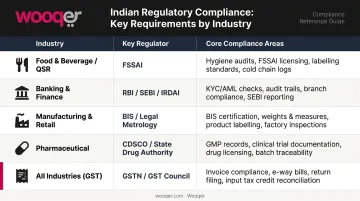
For food businesses operating in more than two states, FSSAI requires a Central License for the head office plus separate licenses or registrations for each unit — a direct multi-location compliance obligation that demands systematic tracking.
Key Elements of an Effective Compliance Management System
The FFIEC's Uniform Interagency Consumer Compliance Rating System — one of the most widely referenced CMS frameworks globally — evaluates compliance management across three primary areas: board and management oversight, the compliance program, and violations of law and consumer harm. ISO 37301:2021 adds structure around establishing, implementing, evaluating, and continuously improving a CMS.
Together, these frameworks point to six operational elements that effective compliance management requires in practice.
Board and Management Oversight
Leadership commitment is the foundation. Without it, compliance efforts remain fragmented and underfunded. Boards of directors must:
- Approve the compliance framework and allocate adequate resources
- Hold senior management accountable for execution
- Extend oversight to third-party vendors and service providers
In Indian banking, the RBI requires Chief Compliance Officers to have at least 15 years of banking or financial services experience — treating compliance leadership as a senior, substantive function rather than an administrative role.
Policies and Procedures
Written, comprehensive, and regularly updated policies define what the organization must do and how. Key requirements:
- Cover all applicable regulations, business lines, and operational activities
- Be accessible to all staff — not locked in a compliance department
- Include a review schedule tied to regulatory changes or new product launches
Training and Education
Compliance training must be role-specific and ongoing. The US Department of Justice explicitly asks whether companies provide tailored training for high-risk and control employees — and Thomson Reuters found that 51% of respondents adopted enhanced employee training in response to increased regulatory scrutiny.
That response reflects a broader reality: one-time onboarding is not enough. Training must be updated whenever regulations change, new products launch, or audit findings reveal knowledge gaps.
Monitoring, Auditing, and Corrective Action
Continuous monitoring catches deviations before they become violations. This element includes:
- Internal audits conducted by in-house teams to assess day-to-day compliance
- External audits performed by independent reviewers for an objective assessment
- Root cause analysis when violations are found — targeting the source, not just the symptom
- Corrective action processes with clear ownership and completion tracking
ACFE's 2024 data shows that internal audit detects 14% of fraud and misconduct cases, compared to 3% from external audit — reinforcing that ongoing internal monitoring is where most compliance gaps get caught first.
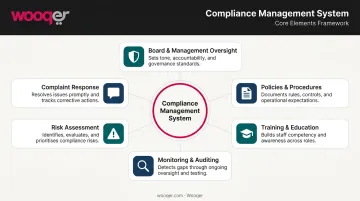
Risk Assessment
A CMS must include a structured process for identifying, evaluating, and prioritising compliance risks. Risk assessments should account for:
- Changes to laws or regulations
- New products, services, or markets
- Operational expansions or new locations
- Shifts in the broader regulatory environment
Assessments should be conducted at regular intervals and scaled to the organization's size and complexity.
Stakeholder Complaint Response
Complaints from customers, employees, or partners are often early warnings of systemic compliance gaps. According to ACFE, tips are the single most common detection method for fraud — accounting for 43% of all cases. A formal complaint process must include:
- Logging and categorising every complaint received
- Investigating root causes, not just resolving the immediate issue
- Tracking resolution status with clear ownership
- Analysing complaint trends to surface systemic problems
The goal is pattern recognition, not case closure.
Benefits of a Compliance Management System
Risk Mitigation and Penalty Avoidance
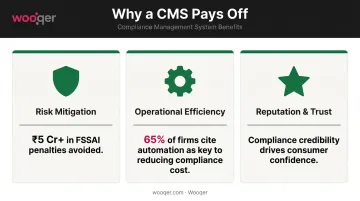
A structured CMS reduces the likelihood of regulatory violations and the financial and legal consequences that follow. In India, the numbers are concrete: FSSAI's enforcement data for 2020-21 recorded 28,347 non-conforming food samples, tens of thousands of civil and criminal cases, and over Rs. 5 crore in penalties. RBI regularly publishes monetary penalties imposed on banks — from co-operative banks to large scheduled commercial banks — for compliance lapses.
The cost of building and maintaining a CMS is reliably lower than the cost of the violations it prevents.
Operational Efficiency and Consistency
Cutting penalties is only part of the value. Integrating compliance into daily workflows also eliminates the inefficiency of ad-hoc, manual processes. The Thomson Reuters 2023 Risk & Compliance Report found that 65% of respondents said streamlining and automating manual processes would reduce risk and compliance complexity and cost.
Specific operational gains from a well-implemented CMS include:
- Standardized processes across all locations, reducing variation and error
- Reduced manual effort through automated checklists and evidence capture
- Improved completion rates with clear accountability and digital audit trails
- Faster audit preparation when documentation is always current and accessible
Reputation, Trust, and Competitive Advantage
Organizations with demonstrable compliance programs build greater trust with customers, investors, and regulators. In sectors like banking, pharma, and food service, regulatory credibility directly affects consumer confidence.
A bank that cannot demonstrate consistent branch compliance, or a QSR chain with visible food safety gaps, loses customer trust — and with it, repeat business and investor confidence. Compliance, in this context, is not just a legal obligation. It's a commercial signal.
Who Is Responsible for Compliance Management?
Compliance is not the sole responsibility of a compliance department. It is a shared organizational function with distinct roles at every level.
Board of Directors
- Sets the overall compliance tone and approves the compliance framework
- Holds ultimate accountability for the organization meeting its legal and regulatory obligations
- Provides resources and demands accountability from management
Senior Management and Compliance Officers
- Translate board-level policy into operational programs
- Appoint compliance officers or teams, conduct risk assessments, deliver training, manage audits
- Report compliance status upward to the board on a regular basis
- In listed companies, SEBI's LODR Regulations 2015 (last amended January 2026) and 2025 clarifications define specific compliance officer responsibilities and disclosure governance obligations, making this a formally regulated role
Employees and Third Parties
- Follow policies, complete required training, and report concerns through defined channels
- Vendors, suppliers, and outsourced providers must meet the same compliance standards as internal staff
- Documented due diligence and ongoing oversight for third parties should be built directly into the CMS
How to Build and Implement a Compliance Management System
ISO 37301:2021 defines the lifecycle of a CMS as: establish, implement, evaluate, maintain, and improve. Here is how that translates into practical steps.
Step 1: Conduct a Compliance Needs Assessment
Before building or upgrading a CMS, map what applies to your organization:
- Which regulations govern each industry sector and geography you operate in?
- Where do current practices fall short of those requirements?
- What is the risk priority — which gaps carry the highest consequence if unaddressed?
This assessment defines the scope and priority of your compliance program.
Step 2: Establish a Compliance Framework with Clear Policies
- Document policies and procedures for each regulatory area
- Assign ownership to specific roles — not just "the compliance team"
- Create an audit trail structure from day one
- Schedule policy reviews at regular intervals or when regulations change
Step 3: Build Training and Communication Programs
- Design role-specific training so each team member understands their personal compliance responsibilities
- Establish clear channels for employees to raise concerns and report violations without fear of retaliation
- Update training whenever regulations change or new products launch
Step 4: Implement Continuous Monitoring and Audit Cycles
- Set up monitoring systems across all locations and business units
- Schedule both internal and external audits on a regular calendar
- Create standardized corrective action processes with assigned owners and completion deadlines
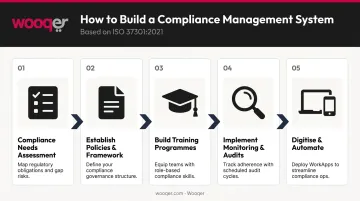
Step 5: Digitize and Automate with the Right Tools
Paper-based and spreadsheet-driven compliance tracking is inadequate for multi-location organizations. It is prone to error, difficult to audit, and impossible to monitor in real time across dozens or hundreds of locations.
Wooqer's mobile-first platform closes that gap for multi-location enterprises. Organizations across banking, food and beverage, pharma, retail, and manufacturing use Wooqer to:
- Access pre-built WorkApps across 20+ industry categories — from HACCP compliance for F&B and GMP audits for pharma, to branch checklists for banking and supplier qualification workflows
- Document every activity as it happens through photo capture with annotations, GPS location verification, and timestamped audit trails
- Generate audit-ready PDF reports instantly, with every action logged and accessible without manual compilation
- Track corrective actions with clear ownership and deadlines across all locations through a centralized analytics dashboard
- Identify recurring compliance gaps before they escalate using completion rate trends and root cause analysis tools
Axis Bank uses Wooqer to standardize operations across 4,500+ branches with real-time compliance tracking, achieving 100% audit compliance. Chai Point achieved 98% food safety compliance and reduced quality incidents by 80% across 180+ outlets. Spencer's Retail reached 95% audit compliance across all stores within three months of implementation.
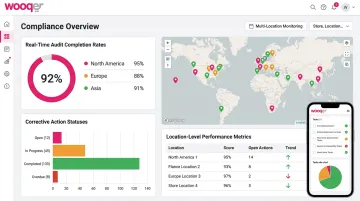
The platform's offline capability means compliance activities continue uninterrupted even at manufacturing sites, warehouses, or rural retail locations with inconsistent connectivity. Data syncs automatically when connection is restored.
Frequently Asked Questions
What is a compliance management system?
A CMS is an integrated framework of processes, controls, and tools that helps organizations systematically meet their legal, regulatory, and ethical obligations. It encompasses board oversight, documented policies, training, monitoring, auditing, and corrective action — not just a single software tool or policy document.
What are the key elements of a compliance management system?
Six core elements make up a complete CMS: board and management oversight, documented policies and procedures, role-specific employee training, risk assessment, continuous monitoring and auditing with corrective action, and a formal complaint response mechanism.
What is the difference between compliance management and a compliance management system?
Compliance management is the overall organizational strategy for meeting regulatory obligations. A CMS is the practical, structured set of tools and processes that operationalize that strategy — turning policy decisions into documented, trackable, auditable activities across the organization.
Who is responsible for a compliance management system?
Responsibility is shared across the organization. The board sets direction and holds ultimate accountability, while compliance officers execute the program through assessments, training, and audits. Every employee, vendor, and third-party provider plays a role by following policies and reporting concerns.
What are the benefits of implementing a compliance management system?
A well-implemented CMS reduces regulatory risk and financial penalties, improves operational efficiency through standardized and automated processes, and builds trust with customers, regulators, and investors.
How do I build an effective compliance management system for a multi-location organization?
Start with a compliance needs assessment to identify regulatory gaps, then document policies with clear ownership and design role-specific training. Deploy a digital platform that provides real-time visibility across all locations — replacing paper records with automated, auditable workflows.
If your organization is ready to move from reactive compliance to a structured, continuously monitored system, Book a Demo to explore how Wooqer supports compliance management across multi-location enterprises, or Try Wooqer and run your first digital compliance audit without any setup complexity.