Introduction
Headquarters designs the perfect promotional display. Regional managers send detailed planograms. Then reality hits: a fraction of locations actually execute it correctly, and nobody knows which ones until it's too late.
This disconnect between strategy and store-level reality is expensive. NIQ reported $48 billion in U.S. retail losses from out-of-stocks in the 52 weeks ending September 2023 — and poor in-store execution is a significant contributor. Retail execution management software exists to close this gap.
Choosing the right platform, though, is its own challenge. The category has shifted considerably — AI-assisted audits, mobile-first field tools, and real-time analytics have become table stakes rather than differentiators. This guide compares five leading options — Wooqer, Repsly, GoSpotCheck by FORM, Reflexis by Zebra, and Axonify — to help operations leaders make a confident, use-case-specific decision.
Key Takeaways
- Retail execution management software digitizes store operations and closes the gap between HQ strategy and field-level reality
- Top 2026 platforms offer mobile-first design, offline capability, AI analytics, and real-time visibility across locations
- Key selection criteria: frontline usability, integration depth, customizability, and measurable outcomes
- The right platform depends on company size, primary use case, and existing tech stack
- Most vendors don't publish pricing — GoSpotCheck by FORM is the only platform with a verified public starting price
What Is Retail Execution Management Software?
Retail execution management software is a digital platform that helps consumer goods companies and multi-location retailers manage in-store activities: merchandising compliance, planogram audits, task management, and promotional execution. Delivery happens through mobile apps, real-time dashboards, and automated reporting.
Gartner's 2025 Market Guide for Retail Execution Management validates the category, describing these solutions as helping FMCG companies and retailers track execution of promotional agreements and adherence to operational standards.
Three broad solution types exist within this space:
- Field sales and CPG merchandising tools — built for reps visiting retail partners, focused on shelf audits, order capture, and account management
- In-store operations and task management platforms — managing daily workflows within owned locations, from opening checklists to promotional setup
- Mobile-first compliance and audit platforms — digitizing inspections and checklists across distributed locations with photo-verified evidence
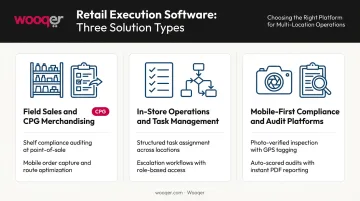
The platforms below span all three types, each with a structured breakdown for direct comparison.
Top Retail Execution Management Software Compared for 2026
These five platforms were evaluated across mobile usability, real-time visibility, customization, AI and analytics capability, integration depth, and suitability for multi-location operations. Here's how each platform stacks up.
Wooqer
Wooqer is an AI-powered, mobile-first platform built for enterprises that need to digitize field operations, audits, and compliance workflows across distributed locations. It serves multi-location retail, QSR, banking, healthcare, and 15+ other sectors, with 450+ enterprise customers across 50,000+ locations in 31 countries.
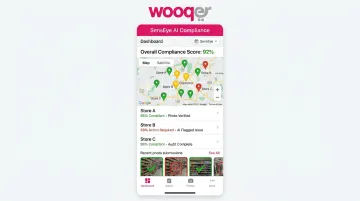
Its standout differentiator is SensEye, an AI-powered visual compliance engine that automatically verifies merchandising execution from submitted store photos. For Lifestyle Stores, SensEye reduced VM rollout time by 85% and pushed VM compliance from 65% to 95% across 80+ stores. Spencer's Retail reached 95% audit compliance (up from 60%) within three months, with 70% faster audit completion.
Other key capabilities:
- App Marketplace with 1,000+ ready-to-use WorkApps across 20 industries, including 55+ retail-specific apps covering store audits, planogram compliance, visual merchandising, loss prevention, and promotional display setup
- True offline capability — photos, GPS data, checklists, and annotations all captured without connectivity; auto-syncs on reconnection
- Corrective action workflows — managers can assign, escalate, and track issue resolution directly in-platform
- Auto-scoring and grading with automated notifications
- Role-based access across three defined roles: Producers (workflow builders), Reviewers (regional managers), and Store Teams (frontline users)
- No per-user pricing — unlimited team members without per-seat cost increases
| Feature Area | Details |
|---|---|
| Key Features | Customizable WorkApps, AI SensEye visual compliance, GPS tracking, photo capture with annotations, corrective action workflows, auto-scoring, instant PDF reports, offline capability, role-based access, calendar scheduling |
| Best For | Multi-location retailers, QSR chains, banks, and enterprises needing scalable compliance and audit digitization across large distributed teams |
| Pricing | Subscription-based annual license with unlimited users; custom pricing available on request (not publicly listed) |
Repsly
Built for small to mid-sized CPG field teams, Repsly simplifies store visit scheduling, data capture, and merchandising compliance through an intuitive mobile interface.
Its strongest differentiator is AI-powered shelf image recognition, with Repsly claiming 95%+ accuracy (and up to 98% SKU recognition in vendor-published benchmarks) — along with audit time reductions of up to 50%. RepIntel analytics adds predictive performance insights for field managers.
Repsly deploys quickly and scores well on mobile UX, but has acknowledged limitations for very large enterprise deployments.
| Feature Area | Details |
|---|---|
| Key Features | AI image recognition for shelf audits, territory and route management, store visit tracking, RepIntel predictive analytics, mobile-first UX, offline data capture |
| Best For | Small to mid-sized CPG brands digitizing field merchandising and audit workflows without heavy IT investment |
| Pricing | Subscription-based; current tiers not publicly verified — check repsly.com/pricing for current rates |
Note: AI accuracy figures are vendor-stated benchmarks, not independently validated.
GoSpotCheck by FORM
GoSpotCheck handles task automation, photo-based compliance documentation, and real-time reporting for retailers, QSR brands, and consumer goods companies that need consistent store-level visibility.
It's the only platform in this comparison with a verified public starting price: Essentials starts at $40/user/month with a 20-user minimum. The Essentials tier includes task builder, unlimited missions and locations, native mobile app, photo capture, web dashboard, and CSV/XLSX reporting.
FORM's image recognition AI can detect and analyze products in minutes, with vendor claims of 75% reduction in survey time. PepsiCo uses GoSpotCheck to determine cooler SKU percentages within two minutes; JOH reduced data collection and report creation time by 56%.
| Feature Area | Details |
|---|---|
| Key Features | Digital task checklists, photo documentation and verification, real-time compliance dashboards, image recognition AI, mobile data collection, multi-location reporting, online and offline data capture |
| Best For | Retail operations and QSR teams needing structured task tracking, visual compliance evidence, and transparent pricing |
| Pricing | Essentials: $40/user/month (20-user minimum); higher tiers available — verify current plans at form.com/pricing/gospotcheck |
Reflexis by Zebra
Reflexis (now Workcloud Task Management) is an enterprise-grade platform from Zebra Technologies built for large retailers. It combines labor scheduling and workforce management with store-level task execution and compliance tracking — a pairing that most retail execution tools don't offer.
A 2022 Forrester Consulting study commissioned by Zebra reported a 348% three-year ROI and $45.85M NPV for Zebra Reflexis. Vera Bradley's on-time corporate task completion rose from 40% to 95% after implementation. Zebra also cites a potential retail sales lift of 1% to 3% from improved execution alignment.
This platform suits organizations where labor efficiency and execution quality are tightly linked — large-format retailers managing thousands of stores with complex workforce scheduling needs.
| Feature Area | Details |
|---|---|
| Key Features | Workforce management and labor scheduling, store task management, compliance tracking, shift-based assignment, Zebra hardware ecosystem integration, enterprise-scale reporting |
| Best For | Large retail chains needing integrated labor scheduling and in-store execution compliance in a single platform |
| Pricing | Enterprise-quoted; no public pricing verified — contact Zebra directly |
Note: ROI figures are from a vendor-commissioned Forrester TEI study.
Axonify
Axonify connects frontline training and knowledge reinforcement directly to task management and communication. Where most platforms push tasks to workers, Axonify focuses on whether those workers understand how to execute them correctly.
Its AI-powered adaptive learning engine delivers personalized microlearning in 3–5 minutes daily, targeting individual knowledge gaps before they cause execution failures. This matters at scale — Axonify's research identifies a 31-point gap between how corporate leaders and frontline employees assess whether information reaches the front line effectively (87% vs. 56%).
Axonify is deployed at Walmart (75,000+ associates), Kroger, Lowe's, Marriott, and Foot Locker. Vendor-reported retail outcomes include 8% sales lift, +$25 average ticket value, and 47% reduction in lost sales.
| Feature Area | Details |
|---|---|
| Key Features | Integrated adaptive training and task management, AI-powered learning reinforcement, frontline communication tools, performance analytics, content marketplace, mobile-first design |
| Best For | Large retailers and hospitality brands where execution failure stems from frontline knowledge gaps, not just missing checklists |
| Pricing | Enterprise-quoted; no public pricing verified — contact Axonify directly |
Note: Outcome figures are vendor-reported; category fit is enablement-first, not merchandising-first.
How We Chose the Best Retail Execution Management Software
Most software selection decisions go wrong before the demo even happens — when teams evaluate platforms on feature lists or brand recognition instead of use case fit. The right starting point is defining your primary need (CPG field rep execution, in-store audit and compliance, or frontline enablement) and then evaluating platforms against that specific requirement.
Key Evaluation Criteria
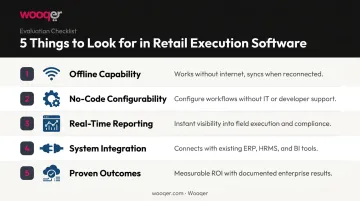
- Works offline without connectivity — frontline teams can't wait for a signal in the back of a store
- Configurable without IT involvement — workflows should match your operations, not the other way around
- Delivers real-time reporting across all locations, not weekly spreadsheet exports
- Integrates with existing POS, HRIS, or ERP systems without a multi-month implementation
- Backs up claims with outcome data from comparable organizations, not generic case studies
A Note on Total Cost of Ownership
Upfront pricing is only part of the picture. A platform that's affordable to start but charges per-user at scale, or requires consultants for every configuration change, often costs more over three years than a no-code, self-serve solution. For enterprises managing hundreds or thousands of frontline workers, unlimited-user pricing models tend to deliver significantly better three-year economics than per-seat alternatives.
When comparing vendors, ask for a total cost projection at your expected team size in year three — not just the entry price.
Conclusion
The best retail execution management software matches your team's specific use case, scales with your operations, and gives frontline workers and managers what they need to execute consistently across every location. Feature count alone won't tell you that.
Before committing, prioritize a hands-on evaluation: involve frontline managers in demos, test offline functionality in real store conditions, and ask vendors for outcome data from organizations comparable to yours — not just marketing claims.
For organizations digitizing audits, compliance workflows, and field operations across multiple locations, Wooqer's customizable WorkApps deliver AI-powered visual compliance, unlimited users, and no heavy IT setup — making it a practical option to evaluate alongside the others on this list.
Frequently Asked Questions
What is retail execution software?
Retail execution software is a digital platform used by retailers and consumer goods companies to manage in-store activities — including merchandising compliance, task management, store audits, and promotional execution — through mobile apps, real-time dashboards, and automated reporting. It replaces paper-based processes with trackable, photo-verified digital workflows.
What features should I look for in retail execution management software?
Prioritize mobile accessibility and offline functionality, digital task checklists, photo capture with evidence collection, real-time compliance dashboards, corrective action workflows, and integration with existing business systems like POS or HRIS. Auto-scoring and role-based access controls are valuable additions for multi-location teams.
How does retail execution software improve store compliance?
It replaces paper checklists with digital workflows that capture timestamped, photo-verified proof of task completion. Operations leaders get real-time visibility into which locations are compliant, and the system triggers automated alerts or corrective actions when standards aren't met — closing the loop before issues escalate.
Can retail execution software work offline on mobile devices?
Most leading platforms offer offline capability, allowing field teams to complete audits, capture photos, and log data without internet connectivity. Data syncs automatically when a connection is restored. This is a baseline requirement for stores with spotty network coverage — confirm offline support before purchasing.
How long does it take to implement retail execution software?
Implementation varies widely. Cloud-based platforms with pre-built templates can go live in days to weeks: Wooqer, for example, cites deployments across 500+ locations in days using its ready-to-use WorkApp marketplace. Enterprise solutions requiring deep ERP or HRIS integration may take several months, depending on customization scope and team size.
What is the difference between retail execution software and store audit software?
Store audit software is a subset of retail execution, focused specifically on inspections and compliance checks. Retail execution management software is broader — covering task management, merchandising execution, field rep tracking, promotional compliance, and analytics. Where audit tools confirm compliance status, execution platforms also surface the root cause and assign accountability for fixing it.
If closing the gap between HQ strategy and in-store reality is a priority for your retail chain, Book a Demo to see how Wooqer's AI-powered WorkApps drive consistent execution across locations, or Try Wooqer to experience the platform across your own store network.