Introduction
Retail customers don't think in channels. They browse on Instagram, compare prices on your website, visit a store to try the product, and expect to return it anywhere — all as one seamless experience. The problem? Most retailers are running disconnected systems that can't keep up.
According to Salesforce research on 15,000+ consumers, 54% of customers feel that sales, service, and marketing teams don't share information — and 65% report having to repeat themselves when switching channels. That friction has a direct cost: PwC's 2025 Customer Experience Survey found that 52% of consumers stopped buying from a brand after a single bad experience.
This guide breaks down omnichannel retail management software for multi-location retailers — what it is, which features actually move the needle, and how to evaluate platforms for your operation.
Key Takeaways
- Omnichannel retail management software unifies inventory, orders, customer data, and store operations across all channels into one system
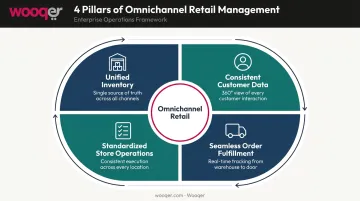
- Four pillars — unified inventory, consistent customer data, seamless fulfilllment, and standardized store operations — must all work together
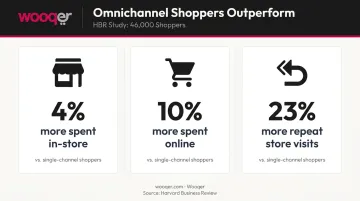
- Omnichannel shoppers spend 4% more in-store and 10% more online than single-channel customers (HBR, 46,000-shopper study)
- Key features to evaluate include real-time inventory, centralized order management, unified customer profiles, analytics, and store operations tools
- Indian retailers must verify vendor compliance with the DPDP Act 2023 and PCI DSS before committing to a platform
What Is Omnichannel Retail Management?
Omnichannel retail management is the strategy and software layer that connects all retail channels — physical stores, ecommerce, mobile, social commerce — into a single coordinated operation. Every channel shares the same data, the same inventory view, and the same customer record.
This is fundamentally different from multichannel retail, where each channel operates independently. A multichannel retailer might have an app, a website, and 50 stores, but each runs on its own data. A customer who bought online is a stranger when they walk into a store. That's the gap omnichannel management closes.
What the Software Actually Does
Omnichannel retail management software centralizes:
- Inventory — one real-time view across all stores, warehouses, and channels
- Orders — a unified queue capturing online, in-store, and marketplace transactions
- Customer data — a single profile tracking purchases, returns, preferences, and loyalty across every touchpoint
- Store operations — digitized processes, compliance checks, and execution standards across all locations
- Reporting — consolidated analytics that show performance across the entire business
To place it in context: an ERP handles backend financials and supply chain, a POS processes transactions at the register, and a WMS manages warehouse logistics. Omnichannel retail management software sits above all three, tying these systems together and filling the gap between backend infrastructure and front-of-house execution.
The 4 Pillars of Omnichannel Retail Management
Omnichannel strategies rarely fail because of one missing feature. They fail when one of four interconnected pillars breaks down — and the breakdown is rarely obvious until customers feel it.
Pillar 1: Unified Inventory
Real-time inventory visibility across every store, warehouse, dark store, and sales channel is the foundation of everything else. Without it, BOPIS promises fail, ship-from-store creates margin problems, and customers get cancelled orders.
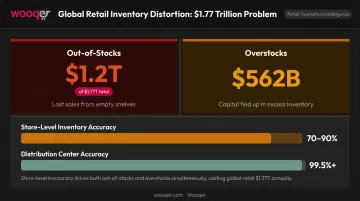
IHL Group's 2023 analysis, reported by Retail TouchPoints, projected $1.77 trillion in global retail inventory distortion, split between $1.2T in out-of-stocks and $562B in overstocks.
McKinsey notes that store-level inventory accuracy typically runs at just 70–90%, versus 99.5%+ in distribution centers. That gap makes stores unreliable as fulfilllment nodes without a unified system managing the data.
Pillar 2: Consistent Customer Data
A 360-degree customer profile — tracking purchases, returns, preferences, and interactions across all channels — is what separates a connected experience from a frustrating one.
When a customer returns an online order in-store, they shouldn't have to explain their purchase history. When a store associate can see that a customer regularly buys premium items online, they can offer a relevant recommendation rather than a generic greeting. McKinsey estimates that effective personalization can reduce customer acquisition costs by up to 50% and lift revenues by 5–15%.
Pillar 3: Seamless Order Fulfilllment
Modern fulfilllment means routing orders from wherever makes the most operational sense: the nearest store, a regional warehouse, or a dark store. Intelligent order routing considers inventory location, proximity to the customer, and shipping cost to select the optimal fulfilllment source automatically.
BOPIS continues growing fast. Click-and-collect sales were forecast to exceed $100B in the US in 2023 and $200B by 2028, per eMarketer data cited by Retail Dive. Capturing that revenue requires accurate inventory data and automated routing logic working in tandem.
Pillar 4: Standardized Store Operations
Most retailers invest heavily in inventory systems and order routing, then underinvest in store-level execution. A retailer can have perfect inventory data and smart order routing, and still deliver an inconsistent customer experience if compliance varies by location.
For multi-location retailers, ensuring that promotions, visual merchandising, SOPs, and compliance standards are executed uniformly across every branch creates real operational complexity. When processes are fragmented and paper-based, even well-designed digital strategies break down at the customer touchpoint.
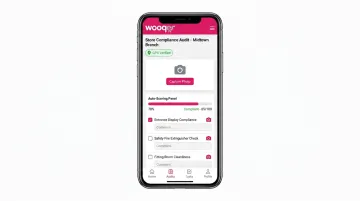
Wooqer addresses this layer directly with mobile-first WorkApps that give retail managers real-time visibility into store compliance across all locations. Each audit captures photo evidence, GPS verification, and auto-scoring, with instant PDF reports available on completion.
Spencer's Retail, operating 200+ stores, went from 60% to 95% audit compliance within three months of deployment.
Must-Have Features of Omnichannel Retail Management Software
Not every platform covers all layers equally. Some are strong on inventory and weak on store operations; others excel at order management but require third-party tools for analytics. Evaluate which capabilities are native versus requiring integration.
Real-Time Inventory Management
Look for:
- Live stock visibility across every store, warehouse, and sales channel
- Automatic inventory updates the moment a sale occurs, regardless of channel
- Low-stock alerts with configurable thresholds
- Stock transfer workflows between locations to balance demand
Centralized Order Management
Smart order routing automatically selects the optimal fulfilllment source based on inventory location, customer proximity, and shipping cost. A unified queue captures online, in-store, and marketplace orders in one place, removing manual decision-making from the process.
Unified Customer Profiles and CRM Integration
The platform should aggregate purchase history, loyalty points, returns, and behavioral data across all channels into a single profile. That profile needs to be accessible to store associates at the POS and customer service teams handling online queries — so a customer exchanging an online purchase in-store never has to re-explain their transaction.
Reporting, Analytics, and AI-Driven Insights
Effective analytics should show:
- Sales performance broken down by channel and location
- Inventory movement trends and fulfilllment KPIs
- Customer behavior patterns across touchpoints
- AI-powered demand forecasting
McKinsey research indicates AI-driven forecasting can reduce forecast errors by 20–50%, translating into inventory reductions of similar magnitude. For high-volume retailers managing thousands of SKUs across dozens of stores, that directly cuts carrying costs and reduces stockouts.
Store Operations and Compliance Management
A complete omnichannel system must also address what happens inside the store. This means digitizing operational checklists, compliance audits, SOP adherence, visual merchandising verification, and corrective action tracking across all locations.
Wooqer's marketplace includes 55+ ready-to-use retail WorkApps covering this layer: Store Opening and Closing Checklists (19K+ users, 4.9 rating), Planogram Compliance (20K+ users, 4.7 rating), and Visual Merchandising Audit (15K+ users, 5.0 rating).
The platform's AI-powered SensEye technology automates VM compliance verification from photos. Lifestyle Stores used it to cut VM implementation time from weeks to hours and push VM compliance from 65% to 95% across 80+ locations.
Key operational features to look for in this layer:
- Mobile-first design with true offline capability (critical for stores with intermittent connectivity)
- Photo capture with annotations as evidence of execution
- GPS-verified audit completion
- Auto-scoring and grading with instant PDF reports
- Multi-level review and approval (MLRA) workflows for escalation
- Role-based access controls so frontline teams, regional reviewers, and operations managers each see what's relevant to their role
Key Benefits of Omnichannel Retail Management Software
Improved Customer Experience and Retention
When inventory data, order history, and promotions are consistent across channels, customers get accurate information every time. No cancelled orders because of stale stock data. No "I'm sorry, I don't have access to your online order" conversations in-store.
An HBR study of 46,000 shoppers found that omnichannel customers spent 4% more in-store and 10% more online than single-channel shoppers, and made 23% more repeat store visits over the following six months. The numbers make a straightforward argument for eliminating channel friction.
Reduced Operational Costs
- Smarter fulfilllment — shipping from the nearest location cuts last-mile costs without requiring same-day infrastructure investment
- Leaner inventory buffers — unified visibility eliminates the need to hold redundant safety stock separately for each channel
- Less manual work — automated order routing and centralized queues reduce the labor hours spent on reconciliation and manual decision-making
Increased Sales Across Channels
Omnichannel software creates sales opportunities that fragmented systems miss:
- Store associates with access to online browsing history can make relevant product recommendations
- Out-of-stock at one location doesn't mean a lost sale — alternate fulfilllment sources fill the gap
- Flexible fulfilllment options (BOPIS, same-day, click & collect) capture customers who would otherwise abandon the purchase
Operational Consistency Across Locations
For multi-location retailers, brand perception is built (or damaged) one store visit at a time. When operations are digitized and tracked, managers gain real-time visibility into whether every branch is executing to standard — not just the ones they visited last week.
Wooqer's platform currently manages 50,000+ stores with a reported 98% compliance rate and 3x faster audit completion. For retail chains where process variability between locations directly affects customer satisfaction, that consistency is where omnichannel ROI gets realized at the ground level.
How to Choose the Right Omnichannel Retail Management Software
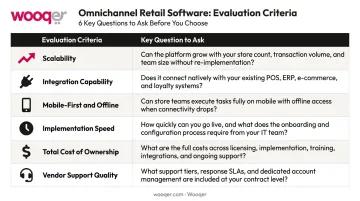
Start by mapping your current gaps before evaluating any platform. Which channels are disconnected? Where do inventory errors occur most? What are the biggest operational pain points across locations? Selecting software against a specific problem list produces better outcomes than chasing feature checklists.
Key Evaluation Criteria
| Criterion | What to Ask |
|---|---|
| Scalability | Can it handle your current store count and a 3x growth scenario? |
| Integration capability | Does it connect with your existing POS, ERP, and ecommerce platform via open APIs? |
| Mobile-first and offline | Can frontline staff use it without reliable internet connectivity? |
| Implementation speed | How long from contract to live? (Wooqer, for reference, rolled out across Spencer's 200+ stores in 6 weeks) |
| Total cost of ownership | Annual license vs. per-seat pricing — understand what scales with headcount |
| Vendor support quality | What does onboarding look like, and what's the support model post-launch? |
Security and Compliance
For Indian retailers, this deserves specific attention. India's Digital Personal Data Protection Act, 2023 requires free, specific, informed, and unambiguous consent for processing personal data. Penalties reach ₹250 crore for failure to implement reasonable security safeguards — meaning any platform handling purchase history, loyalty profiles, or behavioral data must comply.
Beyond DPDP, verify:
- PCI DSS compliance for any platform touching payment card data
- Data encryption (AES-256 at rest, TLS 1.2+ in transit)
- Role-based access controls limiting data exposure to relevant roles only
- RBI tokenisation guidelines compliance for payment data storage
These requirements narrow your shortlist considerably. Wooqer holds ISO 27001 certification and SOC 2 Type II compliance, with AES-256 encryption and MFA — a security foundation built for platforms managing operational and customer data across thousands of retail locations.
Frequently Asked Questions
What is omnichannel retail management?
Omnichannel retail management is the practice of unifying all retail channels (in-store, online, mobile, and social) into a single coordinated operation. It's supported by software that connects inventory, orders, customer data, and store processes in real time, so customers get a consistent experience regardless of how or where they shop.
What is omnichannel software?
Omnichannel software is the technology platform that makes unified retail operations possible. It typically includes modules for inventory management, order management, customer data, store operations, and reporting, integrating with existing systems like POS, ERP, and ecommerce platforms to create one unified data layer.
What are the 4 pillars of omnichannel?
The four pillars are unified inventory, consistent customer data, seamless order fulfilllment, and standardized store operations. All four must work in sync. A breakdown in any one pillar creates gaps in the customer experience, regardless of how strong the other three are.
Which ERP is best for the retail industry?
The right ERP depends on business size and requirements. SAP, Microsoft Dynamics, and Oracle are widely used in enterprise retail. Many retailers layer a dedicated omnichannel retail management solution on top of their ERP to handle channel integration and customer-facing operations while the ERP manages backend financials.
What is the difference between multichannel and omnichannel retail?
Multichannel means selling through multiple channels independently, each with separate data and operations. Omnichannel means all channels share the same data: inventory, customer profiles, and order history. The result is a consistent experience regardless of where or how a customer shops.
If consistent store-level execution is the missing piece in your omnichannel strategy, Book a Demo to see how Wooqer helps multi-location retailers standardize compliance and operations across every branch, or Try Wooqer to get started without any IT setup.