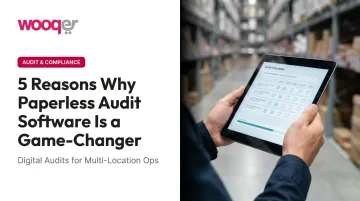
The shift to paperless audit software isn't simply about going digital. It changes the fundamental structure of how audits work — turning a documentation exercise into a continuous control mechanism that delivers consistent standards, real-time visibility, and closed-loop accountability across every location, simultaneously.
This article breaks down five measurable reasons why that shift matters, and what organizations lose when they delay it.
Key Takeaways
- Paperless audit software replaces paper checklists with digital workflows that capture findings, evidence, and scores in real time from any mobile device
- Reporting delays, inconsistent scoring, and lost records — common failures of paper-based audit programs — disappear with digital workflows
- Five measurable advantages: consistent standards, real-time visibility, clear accountability, stronger compliance, and lower cost per audit
- Organizations that digitize see faster issue resolution, higher completion rates, and sharper data for operational decisions
- Built for multi-location operations across retail, QSR, manufacturing, banking, logistics, and pharma
What Is Paperless Audit Software?
Paperless audit software is a digital platform that allows auditors and field teams to plan, conduct, and report on inspections entirely through mobile or web-based tools — replacing paper checklists, manual data entry, and delayed reporting with faster, connected processes.
This applies to operational audits, not just financial ones. Store compliance visits, food safety inspections, quality checks, safety walkthroughs, supplier audits, and mystery visits all fall within scope. The users are operations, compliance, and quality teams — not accountants.
A platform like Wooqer, for example, supports pre-built WorkApps across quality assurance, logistics, retail, banking, and manufacturing — deployable in minutes on any device. Evidence capture typically includes:
- Photo annotations and GPS tagging
- Auto-scoring and instant PDF reports
- Offline capability for field use without internet access
The goal isn't eliminating paper for its own sake. It's making audit data faster, more reliable, and more actionable.
5 Reasons Paperless Audit Software Is a Game-Changer
5 Reasons Paperless Audit Software Delivers Measurable Results
Each reason below maps directly to the outcomes operations, quality, and compliance leaders are accountable for.
Reason 1: Consistent Standards Across Every Location
In paper-based audit programs, the checklist used at one branch may differ from another. Even when the same form is distributed, different auditors interpret criteria differently — producing scores that can't be meaningfully compared across locations.
Paperless audit software addresses this directly. Every auditor sees the same digital form, with the same scoring logic, mandatory fields, and photo evidence requirements. Auto-scoring removes subjective grading. Centrally managed templates mean updates apply across all locations simultaneously.
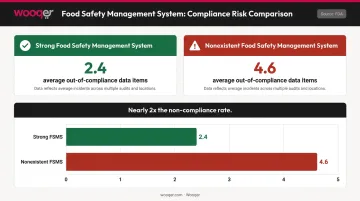
The compliance impact of inconsistent standards is well-documented. An FDA study of deli operations found that establishments with well-developed Food Safety Management Systems averaged 2.4 out-of-compliance data items, compared to 4.6 for those with nonexistent systems — nearly double the non-compliance rate. Inconsistent auditing undermines the management system that prevents those failures.
KPIs this affects:
- Audit score variance across locations
- Non-compliance rates by site or region
- Benchmarking accuracy for performance reviews
Highest impact for businesses operating 10+ locations or managing multiple auditor teams.
Reason 2: Real-Time Visibility Into Field Operations
Paper audits create a reporting lag by design. Findings are recorded on-site, then transcribed, emailed, or manually entered into a spreadsheet. Leadership may not see results for days after an inspection.
Digital audit platforms close this gap. Submissions are instant. Dashboards update as audits are completed. Regional managers can see audit status, scores, and open issues across all locations without waiting for anyone to compile a report. Wooqer's trend analytics dashboards, for instance, give headquarters visibility into performance data across the entire operation — without requiring field teams to prepare summaries.
OSHA identifies response time to safety hazard reports as a direct leading indicator of safety outcomes: slower response signals disengagement, faster response signals control. The same logic applies to food safety violations, compliance gaps, and customer-facing failures.
KPIs this affects:
- Time-to-report
- Issue response time
- Leadership visibility across the location network
Most critical during regulatory inspection cycles, peak seasons, or when managing teams spread across regions.
Reason 3: Clear Accountability and Corrective Action Tracking
Paper audits typically end with a signed form. The finding is documented, but nothing in the process assigns it to a person, sets a deadline, or confirms it was resolved. Follow-up lives in email threads and manual reminders — and often doesn't happen at all.
Paperless audit software automates this chain. When a non-conformance is flagged, corrective action workflows trigger automatically — assigning responsibilities to named individuals, setting deadlines, and sending notifications. Closure requires verification, creating a complete accountability record from finding to resolution.
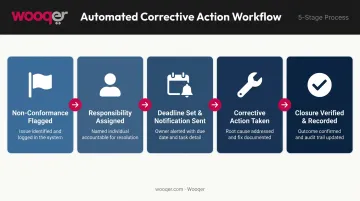
Wooqer's platform includes CAPA tracking and corrective action log WorkApps specifically built for this, with every action timestamped and attributed to the responsible user.
. That gap can turn a manageable finding into a willful violation.
KPIs this affects:
- Audit trail completeness
- Regulatory inspection pass rate
- Documentation retrieval time
Most critical in pharmaceuticals, food and beverage, banking, and logistics — sectors with mandated compliance audit requirements.
Reason 5: Lower Cost and Time Per Audit
The cost of paper audits is rarely tracked as a line item, but it accumulates across every cycle: printing, travel to collect forms, manual data entry, time spent compiling reports, and re-doing audits when records are lost or incomplete.
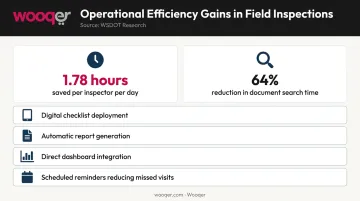
A government study by WSDOT found that mobile field inspection technology saved inspectors an average of 1.78 hours per day compared to traditional processes — and reduced document search time from 8.35 minutes to 2.45 minutes per search, a 64% reduction. Applied across a team conducting audits daily, that's a material recovery of capacity.
Paperless audit software eliminates each cost driver:
- Deploys checklists digitally from a central platform, eliminating printing and physical distribution
- Generates reports automatically, removing manual compilation and data re-entry
- Feeds findings directly to dashboards with no intermediate step
- Reduces missed or duplicate visits through calendar scheduling and automated reminders
Wooqer's WorkApp data shows time savings ranging from 41% to 77% across audit types, with the ability to deploy across 500+ locations in days. Organizations running high-frequency audits — daily, weekly, or monthly — across many locations see the most immediate cost impact.
KPIs this affects:
- Cost per audit
- Audits completed per team member per month
- Time spent on report compilation vs. actual inspection
What Happens When Paper-Based Audits Persist
The consequences of staying on paper don't plateau — they accumulate.
Across multi-location operations, this shows up in predictable ways:
- Audit scores become unreliable as data quality degrades across sites
- Leadership loses visibility into which locations are compliant and which aren't
- Recurring issues go unresolved because there's no systematic follow-through — only the next audit cycle that catches them again
This shifts operations from proactive management to reactive firefighting. Problems surface after a customer complaint, a regulatory notice, or a product failure — rather than being caught during routine inspections.
Scale makes this harder to absorb. Paper audit inefficiencies are manageable at low volume. At 20, 50, or 500 locations — with audits running daily or weekly — administrative overhead grows in direct proportion to location count. LNS Research found that approximately 25% of industrial companies still rely on paper for quality processes, describing it as inefficient, error-prone, and incompatible with analytics.
How to Get the Most Value from Paperless Audit Software
The software enables better audits — but the process around it determines the results. Organizations see the best outcomes when:
- Audits run on a consistent schedule — not ad hoc, but with defined frequency by audit type and location
- Scoring criteria are reviewed regularly — checklists that haven't been updated in two years reflect two-year-old standards
- Findings feed into structured improvement cycles — not filed and forgotten, but tracked to verified closure
- Field teams are trained to capture quality evidence — the difference between a checkbox audit and a useful one is the specificity of what's documented
Adoption is the most common failure point. Wooqer's platform is mobile-first, works on any device, and supports full offline capability — auditors complete inspections without connectivity, with data syncing automatically upon reconnection. For field teams in warehouses, remote sites, or areas with unreliable signal, that single feature removes the biggest adoption barrier.
Training is the other side of adoption. Wooqer Academy provides free, role-specific certification tracks for Producers, Reviewers, and Store Teams, delivered as live instructor-led sessions with practical assessments and verified digital badges. Organizations can schedule team-wide sessions tailored to their specific workflows.
Start with one audit type or one region. Most organizations using Wooqer go live across hundreds of locations within days, using pre-built WorkApp templates that are configurable without developer support.
Conclusion
Paperless audit software changes what audits actually do — not just how they're recorded. Each cycle generates structured data that drives measurable decisions. Over time, organizations that treat paperless auditing as an ongoing practice rather than a one-time rollout build an operational advantage that compounds audit by audit.
The five reasons above — consistent standards, real-time visibility, clear accountability, audit-ready compliance, and lower cost per audit — are each independently valuable. Together, they shift auditing from a documentation exercise into a continuous improvement engine — one that gets more valuable the more locations and cycles it covers.
Frequently Asked Questions
What is paperless audit software?
It's a digital platform used to plan, conduct, and report on audits entirely through mobile or web-based tools. It replaces paper checklists, manual data entry, and delayed reporting with automated, real-time workflows that capture findings, evidence, and scores as audits happen.
How is paperless audit software different from just using spreadsheets or digital forms?
Spreadsheets and standalone forms capture data, but they lack workflow automation, scoring logic, corrective action tracking, real-time dashboards, and audit trail management. Paperless audit software integrates all of these into a single connected process — from inspection to resolution.
Can paperless audit software be used for multi-location businesses?
Multi-location use is one of the primary applications. The software enforces consistent standards across all sites, gives headquarters real-time visibility into each location, and enables performance benchmarking across the network. Wooqer supports operations across 50,000+ locations for enterprise customers.
What types of audits can be managed with paperless audit software?
The software supports store compliance inspections, food safety audits, quality checks, safety walkthroughs, supplier audits, warehouse audits, and mystery visits — across retail, manufacturing, QSR, banking, pharma, and logistics.
How long does it take to transition from paper-based to paperless audits?
Most organizations begin running digital audits within days using pre-built, configurable templates. Starting with one audit type or one region keeps disruption minimal while teams build familiarity before a full rollout.
Does paperless audit software work in areas with poor internet connectivity?
Yes. Purpose-built field audit platforms include offline capability — auditors complete full inspections, including photo capture, without connectivity. Data syncs automatically once a connection is restored, making the platform practical for warehouses, remote sites, and field environments.
Ready to replace paper-based audits with a faster, more reliable process? Book a Demo to see how Wooqer transforms audit workflows across multi-location operations, or Try Wooqer and start digitizing your inspections today.