Introduction
Running a retail store means managing an avalanche of daily tasks — opening and closing checklists, visual merchandising audits, compliance checks, stock replenishment, and team coordination. Multiply that across 50, 100, or 500 locations, and the cracks start to show fast.
Most retail teams still rely on WhatsApp groups, Excel sheets, and paper checklists to manage this complexity. The result? Tasks fall through the cracks, execution varies wildly between stores, and regional managers spend half their day on follow-up calls instead of driving performance.
According to Zebra's 2025 shopper study, 88% of store associates reported challenges getting timely assistance or information — up from 82% the previous year. That gap has a direct cost: missed tasks, inconsistent customer experiences, and compliance failures.
Retail task management software exists to close this gap. Purpose-built platforms give HQ real-time visibility into what's happening on the floor, give store teams clear task ownership, and replace fragmented communication with a structured execution layer — regardless of whether you operate three locations or three hundred.
Here's what to look for in a retail task management platform, and which tools are worth your attention in 2026.
Key Takeaways
- Retail task management software replaces WhatsApp, spreadsheets, and paper checklists with a centralized mobile platform for managing and verifying store-level tasks
- Core features to prioritize: digital checklists with photo proof, geofencing, real-time dashboards, and automated escalations
- Top tools in 2026: Wooqer, YOOBIC, Pazo, ThinkTime, and Bindy — suited to different scales and use cases
- Choose based on team size, location count, mobile usability, integration needs, and compliance requirements
- The right tool cuts manager follow-up time and standardizes execution across every location
What Is Retail Task Management Software?
Retail task management software is a digital platform that lets retail teams assign, track, and verify store-level tasks in real time — replacing manual processes like paper checklists and fragmented messaging apps.
G2 defines the category as software that helps store and franchise managers assign tasks based on store data, receive completion reports, and simplify communication between HQ and retail locations.
The Problems It Solves
In multi-location retail, operational breakdowns follow a predictable pattern:
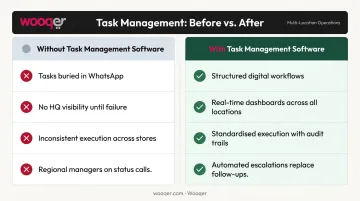
- Tasks assigned via WhatsApp get buried under other messages
- No one at HQ knows which stores completed their opening checks until something goes wrong
- Execution quality varies from store to store with no audit trail
- Regional managers spend hours on status calls instead of coaching
Purpose-built task management tools replace this friction with structured workflows, automated reminders, completion dashboards, and photo-verified audit trails — giving HQ real-time visibility across every location. With more SKUs, more stores, and higher customer expectations in 2026, this kind of operational infrastructure has become central to how retail chains run consistently at scale.
Top Retail Task Management Tools for 2026
These tools were shortlisted based on mobile usability, multi-location support, automation depth, real-time reporting, and customer trust — covering solutions for lean retail teams and large enterprise chains alike.
Wooqer
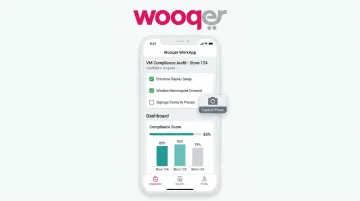
Wooqer is an AI-powered, mobile-first operations platform built specifically for multi-location retail. Teams can digitize daily checklists, audits, SOPs, and visual merchandising workflows through fully customisable WorkApps — deployable in minutes, on any device, with no per-seat pricing and unlimited team members.
What sets Wooqer apart is its AI-Powered SensEye technology, which automatically verifies visual merchandising compliance by analysing submitted photos against brand standards. Lifestyle Stores used SensEye to increase VM compliance from 65% to 95% across 80+ stores and cut implementation time from weeks to hours. Spencer's Retail improved audit compliance from 60% to 95% within three months of deployment.
The App Marketplace includes 55+ retail-specific WorkApps — from Store Opening Checklists and Planogram Compliance to VM Audits and Loss Prevention — each with GPS tracking, auto-scoring, corrective action workflows, offline capability, and a trend analytics dashboard accessible across all store levels.
| Feature Area | Details |
|---|---|
| Key Features | Customisable WorkApps, AI-Powered SensEye, photo capture with annotations, GPS tracking, offline capability, auto-scoring, corrective action tracking, role-based access, calendar scheduling, automated notifications |
| Best For | Multi-location retail chains seeking a mobile-first, customisable platform to standardize SOPs, audits, and VM compliance across all stores |
| Pricing | Annual license model; pricing available on request via demo |
YOOBIC
Built for large multi-site retailers, YOOBIC combines visual merchandising checklists, digital training modules, and HQ-to-store communication in a single mobile platform. Clients include H&M, Boots, Michaels, and Pret A Manger — spanning fashion, beauty, grocery, and specialty retail across hundreds of locations globally.
Its key differentiators include photo-based proof of execution for merchandising compliance, built-in micro-learning for frontline teams, AI-powered performance insights, and integrations with 200+ systems. Boots reported saving $9.4M in labor hours, Michaels achieved 98% compliance, and a global fashion brand reclaimed 55,000 hours annually (all vendor-reported).
| Feature Area | Details |
|---|---|
| Key Features | Visual merchandising checklists, photo verification, micro-learning and onboarding modules, HQ-to-store communications, AI-powered analytics, 200+ integrations |
| Best For | Large multi-site fashion, beauty, or specialty retail chains with complex brand standards and frontline training needs |
| Pricing | Custom quote; contact vendor for pricing |
Pazo
Pazo is a retail-specific task management platform trusted by Jockey, Bata, Sodexo, and Victoria's Secret. It digitizes daily checklists, automates store audits, and manages SOPs with real-time visibility across multiple outlets — designed to be simple enough for floor managers and merchandisers without technical backgrounds.
Standout features include AI-enabled visual merchandising audits, a Pre-Journey Planner (PJP) with geo-fencing for field teams, and built-in team communication tools.
Bata's deployment across 5,300+ stores reported a 66% decrease in store response time, a 5x improvement in operational performance visibility, and a 23% increase in operational efficiency (vendor-reported).
| Feature Area | Details |
|---|---|
| Key Features | Smart digital checklists, AI visual merchandising audits, geo-fenced PJP, built-in team chat, L&D training modules, deep workflow configurability |
| Best For | Retail operations leaders managing 20+ stores who want to cut audit time and reduce manual follow-ups |
| Pricing | Starting around $18–$19/user/month (per review platforms); enterprise pricing on request |
ThinkTime
ThinkTime handles the operational complexity that most task management tools can't. Now part of StoreForce following its acquisition by Accel-KKR in 2023, it centralizes task distribution, validation workflows, and compliance reporting for large national and international store networks running complex corporate initiatives.
Key differentiators include robust follow-up and escalation automation, HQ-to-field dashboards with granular task status visibility, and deep integration with existing retail tech stacks. It's built for organizations where regional reporting requirements and multi-layer compliance tracking are required at every level.
| Feature Area | Details |
|---|---|
| Key Features | Centralized task assignment, validation and follow-up automation, regional and HQ dashboards, compliance reporting, enterprise integrations |
| Best For | Large enterprise retailers running national or international networks with complex HQ-led initiatives and multi-region reporting needs |
| Pricing | Custom-quoted based on network size; contact vendor for pricing |
Bindy (CompliantIA)
Bindy (formerly Compliantia) is an audit and inspection-focused platform purpose-built for compliance-heavy retail environments. It supports multi-location retailers with customisable checklists, offline access, and centralized store data — with a particular strength in regulatory and brand standard audits.
Key differentiators include GPS coordinates and optional geofencing, photo and video verification, 28 built-in reports, and interactive map views for field managers.
Named clients include Skechers, Ashley HomeStores, and The UPS Store Canada. Vendor-reported outcomes include a 70% reduction in site-visit time and 92% improvement in merchandising program execution.
| Feature Area | Details |
|---|---|
| Key Features | Customisable audit checklists and SOPs, photo and video verification, offline access with sync, action plans and follow-up workflows, map views for field teams, 28 built-in reports |
| Best For | Multi-location retailers and regional managers with heavy brand compliance, safety, or regulatory audit requirements |
| Pricing | Starter: $129/month (10 inspections); SMB: $499/month (70 inspections); Enterprise: annual invoice. All plans include unlimited users and sites |
Key Features to Look for in Retail Task Management Software
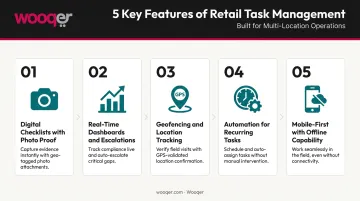
Choosing the wrong platform means your store teams end up with a digital version of the same paper problem. These five capabilities are what distinguish tools built for retail operations from generic project management software repurposed for the floor.
Digital Checklists with Photo Proof
Paper checklists leave no audit trail. Modern platforms require store teams to complete tasks on mobile and upload timestamped photo evidence — giving managers and HQ verifiable proof that every SOP was actually executed, not just ticked off.
Real-Time Dashboards and Escalation Workflows
HQ and regional teams need live visibility into task completion rates, delays, and deviations. Effective platforms auto-escalate missed deadlines to the right person without manual follow-up calls. For retailers managing dozens of stores across different time zones, that automation is the difference between catching a compliance gap on Tuesday versus learning about it on Friday.
Geofencing and Location Tracking
Tasks should only be completable from the physical store location. Geofencing prevents remote or fraudulent submissions. Location-verified completions create an accountability layer that phone-based check-ins cannot replicate — and that matters when you're auditing 50 locations at once.
Automation for Recurring Tasks
Daily opening checks, weekly safety inspections, and monthly audits should auto-schedule — not land on a manager's to-do list each time. When recurring tasks run on autopilot, forgotten deadlines and ad hoc assignments stop being a problem.
Mobile-First Design with Offline Capability
Frontline retail associates consistently report difficulty accessing timely information. A task management platform that requires reliable Wi-Fi fails in basement stockrooms, back offices, and areas with poor connectivity. Without true offline capability — where data syncs automatically once connectivity returns — adoption stalls exactly where you need it most: at the frontline.
How We Chose These Tools
Tools on this list were assessed across five dimensions:
- Mobile usability for frontline teams with varying technical comfort
- Automation depth — recurring tasks, escalations, and corrective action workflows
- Real-time reporting and HQ visibility across locations
- Integration capability with existing retail systems
- Proven deployment in multi-location retail environments
Feature volume alone doesn't make a tool worth deploying. The real test is whether non-technical floor managers and store associates can use the platform daily — without training cycles that drag on for months.
That usability standard only matters if each feature ties back to a measurable outcome. Digital checklists improve SOP compliance rates. Real-time dashboards cut manager follow-up time. Geofencing increases accountability, and automation frees store managers to coach their teams instead of chasing paperwork.
Office Depot's deployment of Zebra Workcloud Task Management across 1,500 stores resulted in a 42% improvement in on-time task completion — a useful benchmark for what structured task management delivers at enterprise scale.
Conclusion
The right retail task management tool gives HQ real-time visibility, holds store teams accountable, and keeps execution consistent across every location — day after day. That's the shift from reactive store management to structured, measurable operations.
Before committing to a platform, assess scalability, mobile usability, and integration fit with your existing tech stack. Run a real-world pilot with actual frontline store staff — because adoption at store level is what determines whether any tool delivers its promised value.
For retail teams looking to digitize operations, standardize SOPs, and gain real-time visibility across stores, Wooqer's no-code WorkApps are designed for multi-location retail — with offline capability, auto-scoring, and instant reports that work from day one. Explore Wooqer or request a demo to see how it fits your operations.
Frequently Asked Questions
What is retail management software?
Retail management software is a centralized digital platform that helps retailers manage daily store operations , including task assignment, compliance audits, inventory tracking, and team communication. It replaces manual tools like spreadsheets and paper checklists with real-time visibility across all locations.
What is the 1-3-5 rule for tasks?
The 1-3-5 rule is a daily prioritization framework: complete 1 big task, 3 medium tasks, and 5 small tasks each day. For retail store managers, it helps structure workloads so high-priority activities don't get crowded out by minor operational to-dos.
How is retail task management software different from general project management tools?
Retail task management software is purpose-built for store operations , with features like shift-based assignments, geofencing, photo proof of completion, and SOP checklists. General project management tools lack the store-level context, mobile-first design, and real-time audit capabilities that frontline retail teams require.
What features should I prioritize when choosing retail task management software?
Focus on these five capabilities:
- Mobile-first design with offline capability
- Digital checklists with photo verification
- Real-time dashboards for HQ visibility
- Automated escalations for missed tasks
- Integration with existing systems like POS or HR platforms
Can retail task management software work for small single-store retailers?
Some platforms offer entry-level plans for single stores, but the real value emerges at scale. Multi-location retailers gain the most from features like centralized dashboards, cross-store compliance tracking, and standardized SOPs — capabilities that matter most when managing teams across several sites.
How do I measure the ROI of retail task management software?
Start by establishing baseline metrics, then track:
- Reduction in manager follow-up time
- Improvement in task completion and SOP compliance rates
- Decrease in audit deviations
- Faster staff onboarding cycles
Comparing pre- and post-implementation data gives you a clear picture of actual ROI.
If you're serious about replacing fragmented retail task management with a platform built for multi-location execution, Book a Demo to see Wooqer's retail WorkApps in action across your store network, or Try Wooqer and get your first store checklist live on any mobile device today.