Introduction
Spreadsheets and random sampling were once the backbone of audit work. That was fine when organizations had a handful of locations and manageable transaction volumes. Today, a retail chain running 500 stores, a bank with thousands of branches, or a QSR brand managing supply chains across regions can't rely on sampling alone — manual processes miss exceptions at scale, and the cost of those gaps has become measurable.
According to Deloitte's 2025 internal audit digital and analytics survey, 90% of internal audit functions now have digital and analytics plans integrated with their strategic objectives. That means most audit teams are no longer asking whether to adopt analytics tools — they're deciding which ones to use and how.
That decision isn't straightforward. Today's tools range from AI-driven transaction anomaly detection in financial ledgers to mobile-first field inspections across hundreds of physical locations. Applying a financial audit tool to an operational audit problem wastes budget and kills adoption — the fit between tool type and audit type matters more than most buyers anticipate.
This guide covers five leading audit analytics platforms, what each does best, and how to match the right tool to your audit type.
Key Takeaways
- Audit analytics replaces sampling with automated, full-population analysis — improving accuracy, speed, and compliance confidence.
- Financial audit teams should evaluate MindBridge AI and DataSnipper; enterprise GRC functions should look at AuditBoard and Diligent HighBond.
- Wooqer targets multi-location operational audits (retail, QSR, banking, manufacturing) with mobile-first workflows, GPS, photo capture, and corrective action tracking built in.
- Key selection criteria: AI capability, mobile/offline access, integration depth, corrective action tracking, and actual fit with your audit type.
- Top tools now apply AI for anomaly detection, auto-scoring, and predictive risk flagging.
What Is Audit Analytics and Why Does It Matter?
The AICPA defines audit data analytics as the science and art of discovering and analyzing patterns, identifying anomalies, and extracting useful information from data through analysis, modeling, and visualization. The practical implication: auditors can move beyond testing a 10% sample and instead examine every record — every transaction, every checklist submission, every process step.
Two distinct categories exist:
- Financial audit analytics — examines ledgers, invoices, journal entries, and transaction data to detect fraud, misstatements, and control failures
- Operational audit analytics — evaluates field inspections, process compliance, and SOP adherence across physical locations or business units
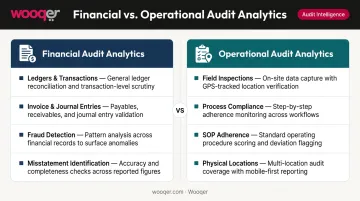
Most organizations need both. A retailer running 200 stores must audit both its financial controls and its on-ground execution — stock handling, safety compliance, merchandising standards — and these require entirely different tools.
At that scale, the cost of gaps is concrete. The ACFE and SAS reported in 2024 that 91% of organizations use data analysis techniques in anti-fraud programs, and 59% plan to increase anti-fraud technology budgets — meaning audit teams that still rely on sampling and spreadsheets are already behind the standard their peers have set.
Best Audit Analytics Tools and Software Solutions
The tools below were evaluated on analytical depth, ease of deployment, mobile and offline capability, integration breadth, and suitability across financial, operational, and compliance audit types.
Wooqer
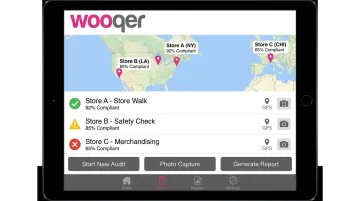
Wooqer is a mobile-first audit and compliance platform built for organizations managing field operations, store visits, safety inspections, and process audits across multiple locations. It serves retail, QSR, banking, manufacturing, and logistics organizations — currently deployed across 450+ enterprise customers, 50,000+ locations, and 31 countries, processing over 1 million daily tasks.
Unlike financial audit tools that analyze data already sitting in accounting systems, Wooqer captures compliance data at the point of work — on the shop floor, at a bank branch, or a warehouse dock — via any mobile device, including in offline mode. That operational focus is what separates it from every other platform on this list.
Notable customers include Axis Bank (4,500+ branches), Apollo Pharmacy (5,000+ locations), Domino's Pizza (1,500+ stores), and Tata Motors.
| Category | Details |
|---|---|
| Key Features | Mobile-first audit forms, AI-powered SensEye visual verification, auto-scoring, corrective action workflows, GPS tracking, photo capture with annotations, instant PDF reports, role-based access, trend analytics dashboard, offline mode, calendar scheduling, automated notifications |
| Best For | Retail, QSR, banking, manufacturing, logistics, and pharmaceutical organizations running multi-location operational audits, compliance checks, and field inspections |
| App Marketplace | 300+ ready-to-use WorkApps including Branch Audit, 5S Audit, Warehouse Audit, Safety Audit, Equipment Checklist, and Drive-Thru Audit — deployable in minutes |
| Security | SOC 2 Type II, ISO 27001, GDPR compliant; AES-256 encryption, MFA, SSO |
| Deployment & Pricing | Cloud-based SaaS; works on any device; unlimited team members; contact Wooqer for pricing |
AuditBoard
AuditBoard (now operating as Optro) is a cloud-native platform that consolidates internal audit, risk management, compliance monitoring, and ESG workflows into a single environment. Mid-to-large enterprises use it to connect their audit function directly to risk and compliance operations. The platform includes AI Scoping Memos, AI Cross-Audit Summaries, and a continuous monitoring engine that evaluates entire data populations rather than samples. It earned 2024 Gartner Peer Insights Customers' Choice recognition for Audit Management Solutions, with 89% reviewer willingness to recommend (vendor-reported).
| Category | Details |
|---|---|
| Key Features | Audit lifecycle management, AI-assisted documentation, risk heat maps, compliance automation, ESG reporting, real-time dashboards, issue tracking, remediation workflows, 30+ preloaded frameworks (SOC 2, ISO 27001) |
| Best For | Mid-to-large enterprises requiring a unified internal audit, risk, compliance, and ESG platform |
| Deployment & Pricing | Cloud-based; enterprise-tier; pricing on request |
Diligent HighBond (formerly ACL)
Diligent HighBond traces its lineage directly to ACL Analytics, the platform that pioneered data-driven audit testing before being absorbed into the broader GRC suite. Today it retains that analytical depth through ACLScript, a command language for programming and automating analytics workflows.
HighBond suits audit teams that need both GRC workflow management and programmable exception testing. Its continuous audit and monitoring capabilities, risk-based planning tools, and pre-configured audit templates make it a strong fit for compliance-heavy industries. The platform is FedRAMP authorized and serves 25,000+ customers across 130 countries (vendor-reported).
| Category | Details |
|---|---|
| Key Features | Continuous audit and monitoring, compliance workflow automation, risk-based audit planning, pre-configured templates, ACLScript analytics scripting, centralized issue management |
| Best For | Enterprise GRC teams, compliance-heavy industries, and internal audit functions with technical scripting expertise |
| Deployment & Pricing | Cloud-based SaaS; pricing by module and scale; contact vendor |
MindBridge AI
MindBridge AI is built specifically for financial transaction analysis. It analyzes 100% of transactions across financial systems using Ensemble AI, which layers machine learning, statistical methods, and rules-based testing across 40+ control points to evaluate risk across the full dataset. By 2023, the platform had scored over 100 billion financial entries (vendor-reported).
Rather than waiting for auditors to define specific tests, MindBridge learns from data patterns and surfaces high-risk transactions proactively. A Cherry Bekaert case study reported a 66% reduction in sample size for certain engagements; Pinion reported 20–25% fewer expected engagement hours — both are vendor case-study claims and shouldn't be generalized.
| Category | Details |
|---|---|
| Key Features | AI-driven anomaly detection, transaction risk scoring, full-population financial analysis, Ensemble AI, fraud risk flagging, accounting system integrations |
| Best For | Financial audit teams, internal auditors, and accountants analyzing large transaction datasets for risk and fraud |
| Security | SOC 2, SOC 3, ISO 27001:2013 certified |
| Deployment & Pricing | Cloud-based; suited for mid-to-large audit functions; contact vendor for pricing |
DataSnipper
DataSnipper operates entirely inside Microsoft Excel, making it a natural fit for external audit firms that already live in spreadsheets. Rather than pulling auditors into a new environment, it adds intelligent automation directly to Excel: OCR extraction, document matching, cross-referencing, and AI-driven evidence capture.
Used by all four Big Four accounting firms and 600,000+ finance professionals in 175+ countries (vendor-reported), DataSnipper earned G2's number one ranking in Financial Audit Software with a 4.8-star rating. Its UpLink client collaboration portal and AI agents for disclosure tasks make it especially practical for evidence-heavy financial statement audits.
| Category | Details |
|---|---|
| Key Features | Excel-native AI evidence matching, intelligent OCR, cross-referencing automation, financial statement suite, UpLink client collaboration portal, AI agents for audit and disclosure tasks |
| Best For | External audit firms, CPA practices, and accounting teams conducting financial statement audits and tests of details |
| Deployment & Pricing | Excel add-in (cloud-enabled); used by global accounting firms; free demo available; contact vendor for pricing |
How to Choose the Right Audit Analytics Tool
The most common procurement mistake is choosing a well-known platform without confirming it fits your actual audit workflow. Brand recognition is not a substitute for functional fit.
Match Tool Type to Audit Type
This is the single most important criterion:
- Financial audit teams need data integration depth, AI anomaly detection, and transaction risk scoring → MindBridge AI or DataSnipper
- Enterprise GRC and internal audit functions need connected risk workflows, compliance automation, and reporting → AuditBoard or Diligent HighBond
- Field-based operational audit teams managing multi-location inspections need mobile-first design, GPS, photo evidence, and corrective action tracking → Wooqer
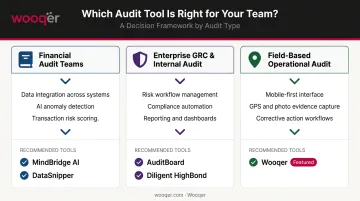
A GRC platform built for enterprise risk reporting won't help a regional manager audit 80 stores — and a financial analytics tool has no mechanism for verifying whether a restaurant's food safety checklist was completed at 6am.
Additional Evaluation Criteria
Beyond fit, weight these factors during evaluation:
- Data coverage: does the tool test 100% of records, or does it rely on samples?
- Ease of deployment: can non-technical users configure and launch it without IT dependency?
- Mobile and offline capability — essential for field teams in areas with unreliable connectivity
- Corrective action workflows: findings without follow-through accountability produce reports, not results
- Integration capability: connections to ERP, HRMS, POS, and BI systems prevent data silos
- Security standards — SOC 2 Type II and ISO 27001 are the benchmarks for enterprise procurement
- Scalability: does pricing scale by user, location, or module, and does that model fit your team size?
One underweighted factor is post-implementation support. Configuration complexity and specialist dependency add real costs — ask vendors specifically how long average onboarding takes and whether your team can self-serve changes after go-live.
Frequently Asked Questions
How is data analytics used in audit?
Data analytics in audit applies statistical and AI-driven techniques to examine entire datasets — rather than samples — to detect anomalies, fraud, errors, and policy violations. It covers all audit phases: planning, fieldwork, and reporting, replacing selective sampling with full transaction testing.
Which software is used for audit?
The right choice depends on audit type. Financial audit teams use tools like MindBridge AI and DataSnipper. Enterprise GRC and internal audit functions use AuditBoard or Diligent HighBond. Organizations running operational and field audits across multiple locations use platforms like Wooqer.
What are the four types of data analytics?
Descriptive (what happened), diagnostic (why it happened), predictive (what might happen), and prescriptive (what should be done), as defined by Gartner. Most audit analytics platforms combine all four to surface patterns, identify root causes, and flag at-risk areas.
What is the difference between financial and operational audit analytics?
Financial audit analytics focuses on transaction data, ledgers, and financial statements to detect fraud or misstatement. Operational audit analytics focuses on process compliance, field inspections, and SOP adherence across physical locations or business units. Each discipline requires purpose-built tools.
What features should I look for in audit analytics software?
Prioritize these capabilities when evaluating options:
- 100% data coverage (not just sampling) with AI-driven anomaly detection
- Mobile accessibility, offline capability, and corrective action tracking
- Real-time dashboards, system integrations, and role-based access controls
- Security certifications (SOC 2 Type II, ISO 27001) for enterprise deployments
Can audit analytics tools support multi-location businesses?
Yes. Platforms like Wooqer are built specifically for multi-location operations, with GPS tracking, location-wise compliance visibility, auto-scoring, and centralized real-time reporting. Generic GRC tools typically lack the mobile-first, field-level capabilities that distributed teams need.
Conclusion
Audit analytics has moved well beyond ledger analysis. The best platforms today cover the full spectrum — from AI-driven transaction anomaly detection in accounting software to mobile-first field inspections and corrective action tracking across hundreds of physical locations.
The clearest mistake in this category is selecting a tool based on category reputation rather than audit context. Financial audit teams and operational audit teams have genuinely different needs, and a mismatch between tool type and use case leads to poor adoption and limited return.
If your work falls on the operational side, the right fit typically checks these boxes:
- Mobile-first design that works on any device, including offline
- Photo and evidence capture built into the workflow
- Corrective action tracking with clear ownership
- Real-time visibility across multiple locations
For teams running store visits, compliance checks, or field inspections across multiple locations, Wooqer is worth evaluating. Its AI-powered mobile WorkApps cover the full operational audit cycle — evidence capture, auto-scoring, and corrective action tracking — on any device, deployable without IT involvement.
To see how operational audit analytics work in practice across hundreds of locations, Book a Demo with Wooqer's team, or Try Wooqer and run a live audit across your locations within the same day.