Introduction
Picture this: a factory inspector walks unannounced into one of your plants. Your safety officer scrambles through filing cabinets looking for the last fire safety audit. The incident register is a handwritten notebook. PPE compliance records from three months ago are missing entirely.
This scenario plays out regularly across Indian manufacturing, logistics, construction, and retail operations. According to the ILO, occupational accidents and diseases cost approximately 4% of global GDP. For organizations relying on paper-based EHS tracking, that exposure grows with every unrecorded near-miss and every missed permit renewal.
The penalties are concrete: the Factories Act 1948 allows imprisonment up to 7 years for hazardous-process violations. Keeping pace with the rules isn't simple either — TeamLease RegTech tracked 9,331 regulatory updates in India in 2024 alone.
This guide covers what EHS management actually means, its five core pillars, the real cost of non-compliance, common operational challenges, and a practical framework for building a program that holds up under scrutiny.
Key Takeaways
- EHS management is a structured system to protect workers, minimize environmental impact, and meet regulatory requirements — not a box-ticking exercise you complete once and file away.
- Weak EHS compliance costs organizations through fines, shutdowns, reputational damage, and — most critically — preventable injuries.
- Five pillars drive effective EHS programs: hazard identification, incident management, compliance tracking, team training, and continuous improvement.
- For multi-location operations, digital systems are the only practical way to enforce consistent standards and keep inspection-ready records across every site.
What Is EHS Management and Why Does It Matter?
EHS management is the integrated, ongoing practice of identifying, assessing, and controlling risks across three connected domains:
- Environmental — managing waste, emissions, water usage, and regulatory environmental permits
- Health — monitoring occupational exposure, chemical hazards, and overall worker wellbeing
- Safety — preventing injuries through hazard controls, safe work procedures, and protective equipment
The distinction between management and compliance matters. Compliance means meeting specific regulatory obligations — India's Factories Act 1948, Environment Protection Act 1986, Mines Act 1952, and the Building and Other Construction Workers Act 1996 among them. Management is the proactive system that makes compliance a natural, documented outcome rather than a last-minute scramble before an audit.
The Business Case Beyond Regulation
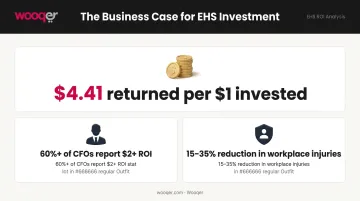
EHS is not simply a legal cost center. A US-based study by the National Safety Council found that more than 60% of CFOs saw a $2+ return for every $1 invested in injury prevention, with an average perceived ROI of $4.41 per dollar — a benchmark consistently echoed across global markets. Mature EHS programs reduce workplace injuries by 15% to 35%, translating directly into lower compensation costs, fewer operational disruptions, and higher productivity.
There are also less quantifiable but real business outcomes:
- Employee retention improves when workers feel protected on the job
- Enterprise clients increasingly audit supply chains for EHS standards before awarding contracts
- Investors treat safety performance as a proxy for broader operational discipline
Who Is Responsible?
EHS responsibility does not sit exclusively with the EHS officer. High-performing safety cultures distribute accountability across:
- Leadership — sets the tone, allocates resources, and treats EHS as a business priority
- Operations managers — own day-to-day hazard controls and ensure procedures are followed
- Frontline workers — report near-misses, follow safe work practices, and participate in audits
Organizations that concentrate EHS in a single role tend to stay reactive — responding to incidents rather than preventing them. Distributed accountability is what shifts safety from a compliance checkbox into an operational standard.
Key Pillars of an Effective EHS Management System
Hazard Identification and Risk Assessment
No EHS activity is effective without a clear picture of what hazards exist. OSHA defines Job Hazard Analysis (JHA) as a structured technique examining the relationship between the worker, the task, the tools, and the work environment, with the goal of identifying hazards before incidents occur.
In practice, this means:
- Systematically identifying hazards across physical, chemical, ergonomic, and biological categories
- Assessing likelihood and severity using risk matrices to prioritize which hazards need immediate controls
- Maintaining a risk register — a living document that tracks each identified hazard, its assigned owner, mitigation actions taken, and scheduled review dates
The risk register is not a one-time deliverable. It should be updated after every incident, near-miss, operational change, or inspection finding.
Incident Management and Root Cause Analysis
The incident lifecycle has a specific shape that organizations frequently short-circuit:
- Report — capture the incident, including near-misses
- Investigate — gather facts before memories fade
- Root cause analysis — identify the underlying system failure, not just the immediate trigger
- CAPA — assign corrective and preventive actions with named owners and deadlines
- Closure — verify the fix worked and update the risk register
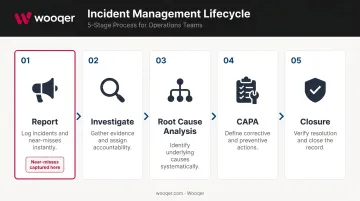
Near-miss reporting deserves special emphasis. OSHA and the NSC both confirm that near-miss reporting is critical to preventing serious, fatal, and catastrophic incidents. Organizations that only log actual injuries are missing the leading indicators that predict where the next serious event will occur.
Root cause analysis tools — whether a structured 5 Whys approach or a cause-and-effect diagram — serve one purpose: identifying the system failure that allowed the incident to happen. Wooqer's Root Cause Analysis WorkApp (used by over 6,000 users) and its Near Miss Report WorkApp (adopted by 12,000+ users with a 98% completion rate) support this full incident-to-closure workflow digitally.
Regulatory Compliance Tracking
Closing incidents correctly is only half the picture — organizations also need to stay ahead of the regulations that govern when and how they operate. India's compliance environment is genuinely complex: TeamLease RegTech's research documents 1,536 Acts, 69,233 compliances, and 9,331 regulatory updates in 2024. For a single large manufacturing plant, that can translate to 9,500+ compliances and 940+ filings.
A legal register is the only reliable way to manage this volume. It should track applicable regulations, specific obligations, permit renewal dates, audit schedules, and responsible owners in one place. Requirements also vary by state — Gujarat and Maharashtra differ on drinking-water cooling thresholds and safety committee triggers under their respective Factories Rules. A spreadsheet shared by email cannot flag a state-level amendment reliably.
Training and Competency Management
The Factories Act Section 111A establishes worker training as a right, not just an employer obligation. Section 41C further requires factories with hazardous processes to appoint qualified personnel to supervise hazardous substance handling.
The critical distinction: training completion (did the worker attend?) is a compliance metric. Demonstrated competency (can the worker identify a hazard and respond correctly?) is the actual safety outcome. IOSH-funded research found that training interventions reduced accidents by an average of 22% over 24 months — but only when training was genuinely absorbed, not just documented.
Wooqer's Safety Training Log WorkApp supports certification tracking for 4,000+ users, creating an auditable record of who was trained, when, and on what topics.
The Real Cost of EHS Non-Compliance
Financial Penalties Under Indian Law
The statutory exposure is significant and specific:
| Legislation | Violation | Maximum Penalty |
|---|---|---|
| Factories Act, Section 92 | General contravention | 2 years imprisonment, ₹1 lakh fine |
| Factories Act, Section 92 (death) | Contravention causing death | Minimum ₹25,000 fine |
| Factories Act, Section 96A | Hazardous process violation | 7 years imprisonment, ₹2 lakh fine (up to 10 years for repeat violations) |
| BOCW Act, Section 47 | Safety/health/welfare rules | 3 months imprisonment, ₹2,000 fine |
| Mines Act | Falsification of records | 3 months imprisonment, ₹1,000 fine |
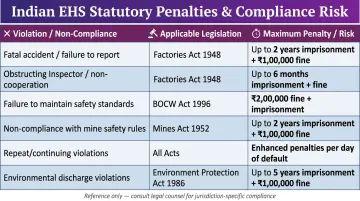
Beyond statutory fines: litigation costs, insurance premium increases, and operational shutdowns can dwarf the direct penalty. A serious incident that shuts down a production line for two weeks costs far more than the regulatory fine itself.
Human and Reputational Costs
Workplace injuries and fatalities carry costs that no penalty table captures: loss of life, permanent disability, and the psychological impact on the workers who witness them. For the organization, the downstream effects include:
- Difficulty attracting skilled workers to sites with poor safety records
- Loss of enterprise contracts from clients who conduct supply chain EHS audits
- Media and regulatory scrutiny that compounds reputational damage
Prevention Costs a Fraction of Recovery
Research cited by the National Safety Council shows that a serious or fatal incident costs 48 times the associated preventive measure. Organizations that delay EHS investment until after an incident are not saving money. They are accumulating a much larger bill.
Common EHS Compliance Challenges Organizations Face
Three operational problems consistently stop organizations from closing the gap between EHS intent and actual compliance.
Data fragmentation undermines visibility at the leadership level. When EHS data lives in paper forms, local spreadsheets, and individual email threads, no one can see the organization's real compliance status. Wolters Kluwer found that only 11% of organizations have fully digitalized EHS systems, while 18% still rely primarily on manual or paper-based processes.
The 71% in hybrid workflows face their own problem: partial digitization creates inconsistent records that are difficult to audit.
Regulatory change management is a genuine operational challenge for any Indian organization spanning multiple states. When Maharashtra amends its factory safety committee rules or a new environmental notification is issued, two questions matter: who in your organization finds out, and how quickly does that change reach the site that needs to act on it?
Inconsistent standards across locations compound both problems above. Without a centralized system, EHS practices vary between sites — often shaped by an individual manager's habits rather than company policy. The results are predictable:
- Audit failures at some locations while others pass cleanly
- Unequal worker protection across the same organization
- No way to demonstrate enterprise-wide compliance to a regulator or a client conducting a vendor audit
Building an Effective EHS Compliance Program
Step 1 — Conduct a Baseline Gap Assessment
Before adding processes, map the current state. Compare existing EHS practices against applicable regulations and relevant standards (ISO 45001:2018, which replaced OHSAS 18001, provides a widely used framework for occupational health and safety management systems). Identify gaps in documentation, process ownership, and accountability. The goal is a clear picture of where the highest-risk gaps sit, so effort is prioritized correctly.
Step 2 — Define Roles, Responsibilities, and Accountability
Every EHS obligation needs a named owner with a deadline. Verbal delegation does not survive personnel changes, and it fails audits. Role-based assignment — where responsibilities are formally recorded in the system rather than implied — creates accountability that is visible, trackable, and auditable. This is also where the "everyone's responsibility" principle becomes operational rather than aspirational.
Step 3 — Digitize Inspections, Audits, and Reporting
Moving from paper checklists to digital inspection workflows does more than save filing time. It enables:
- Real-time data capture with photo evidence and GPS tagging
- Instant report generation after every inspection
- Automatic corrective action assignment with named owners and deadlines
- Audit-ready records accessible from any device
Wooqer's mobile-first WorkApps cover this entire spectrum, with Health Safety Checklists alone adopted by 14,000+ users at a 93% completion rate. Teams can conduct inspections offline and sync automatically when connectivity is restored — a critical advantage on construction sites, in remote facilities, and across warehouses. Pre-built templates deploy in minutes without IT involvement.
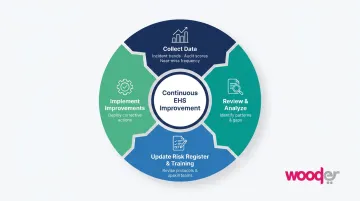
Step 4 — Establish a Continuous Improvement Loop
A well-run EHS program is a continuous cycle, not a static document. Use data from incident trends, audit scores, and near-miss frequency to drive regular reviews, update the risk register, and improve training content. Organizations that treat their EHS program as a compliance checkbox tend to repeat the same incidents; those that use their data to improve get measurably better outcomes over time.
Choosing the Right EHS Management Software
Core Capabilities That Are Non-Negotiable
Any EHS software shortlist should be assessed against these baseline requirements:
- Mobile-first inspections — field teams need to work from phones and tablets, not desktop terminals
- Offline capability — inspections cannot depend on network availability
- Incident logging with root cause tracking — from near-miss capture through to CAPA closure
- Regulatory compliance scheduling — permit renewals, audit deadlines, and obligation tracking with automated reminders
- Real-time reporting dashboards — leadership needs current compliance status, not last month's spreadsheet
Scalability and Multi-Location Support
For organizations operating multiple plants, warehouses, retail locations, or construction sites, the platform must enforce consistent standards across every location — not just the flagship site.
The ability to track completion rates by site, identify locations falling behind, and drill into specific findings remotely gives EHS managers actual control over distributed operations.
This is where platform architecture matters. Wooqer is built specifically for multi-location operations — consistent EHS standards deploy across hundreds of locations simultaneously, with role-based access ensuring a regional manager sees their region's data, a site supervisor sees their site, and leadership sees the enterprise view.
Implementation and Adoption Realities
The best EHS software is the one frontline workers actually use. Evaluate:
- Goes live in days across multiple locations, not after a multi-month IT project
- Works fully offline — not just partially — so field teams aren't blocked by poor connectivity
- Runs on any smartphone without requiring specific hardware
- Configurable by operations teams directly, without IT involvement
Software that requires a six-month implementation before a single checklist is completed provides no value during that period. Wooqer's no-code WorkApps can be deployed across 500+ locations within days — with inspections running, incidents being logged, and compliance schedules active from the first week.
Frequently Asked Questions
What is EHS compliance software?
EHS compliance software is a digital platform that helps organizations automate regulatory tracking, manage inspections and audits, log incidents, assign corrective actions, and generate compliance reports. It replaces paper-based and spreadsheet processes with a centralized, audit-ready system accessible from any device.
How do you choose the right EHS software?
Prioritize mobile usability, offline capability, automation of compliance tasks, and multi-location support. Configurability for your industry's specific requirements and ease of deployment for frontline teams matter as much as feature depth — a platform your teams won't use consistently is no solution at all.
Who uses EHS software?
EHS software is used across manufacturing, logistics, construction, pharmaceuticals, retail, energy, banking, and automotive sectors. Primary users include EHS managers, safety officers, operations leaders, and frontline supervisors. They track compliance, log incidents, and report to regulators or enterprise clients.
What are the key components of an EHS management system?
Five core components: hazard identification and risk assessment, incident management and root cause analysis, regulatory compliance tracking, EHS training and competency management, and continuous improvement through data-driven reviews. All five need to run in parallel, not in sequence.
What are the consequences of poor EHS compliance?
Financial penalties under the Factories Act can include imprisonment up to 7 years and fines up to Rs. 2 lakh for hazardous-process violations. Beyond penalties: operational shutdowns, litigation, insurance increases, reputational damage, and the preventable human cost of workplace injuries or fatalities. Proactive compliance management costs a fraction of reactive incident response.
What is the difference between EHS and HSE?
EHS (Environment, Health, Safety) and HSE (Health, Safety, Environment) refer to the same discipline with identical components — the terminology varies by industry and region. The underlying practices, regulatory obligations, and organizational goals are the same regardless of which acronym is used.
If your EHS program needs to move from paper-based tracking to real-time visibility across every plant, warehouse, or site, Book a Demo to see how Wooqer's mobile-first WorkApps support the full EHS compliance lifecycle, or Try Wooqer and run your first digital safety inspection today.