ISO 37301 is the global benchmark for building a Compliance Management System (CMS) that actually works. Published by ISO in April 2021, it gives organizations a structured, certifiable framework for embedding compliance into culture, governance, and operations — not just documentation.
This article covers what ISO 37301 is, how it differs from ISO 19600, its core requirements, the certification process, and how to implement it practically.
Key Takeaways
- ISO 37301 replaced ISO 19600 in April 2021 and is a certifiable (Type A) international standard for compliance management systems
- It is built around seven core clauses — context, leadership, planning, support, operations, performance evaluation, and improvement
- The standard follows the Plan-Do-Check-Act (PDCA) cycle, making continuous improvement a core requirement, not an afterthought
- Certification is voluntary but delivers real competitive and reputational advantages in regulated industries
- Practical implementation means centralising obligations, assigning clear accountability, and monitoring compliance in real time
What Is ISO 37301 and Why It Replaced ISO 19600
ISO 37301:2021 sets out requirements for building, implementing, and maintaining an effective Compliance Management System (CMS). It applies to all organization types — private, public, and non-profit — regardless of size, industry, or geography.
A CMS is not just a folder of policies. It is a cohesive set of processes, controls, governance structures, and tools that helps an organization meet both:
- External obligations — laws, regulations, court orders, licensing conditions
- Internal obligations — voluntary codes of conduct, ESG commitments, contractual pledges
Replacing ISO 19600: What Changed and Why It Matters
ISO 19600 (published December 2014) was a Type B management system standard — meaning it provided guidance and recommendations, not binding requirements. Organizations could follow it, but could not get certified against it.
ISO 37301 is a Type A standard. That distinction has direct practical consequences:
| Feature | ISO 19600 | ISO 37301 |
|---|---|---|
| Type | Type B (guidance) | Type A (requirements) |
| Certifiable | No | Yes |
| Whistleblowing requirements | Limited | Explicit and robust |
| ESG/voluntary obligations | Not formally addressed | Included as compliance obligations |
| Risk-based approach | Basic | Strengthened |
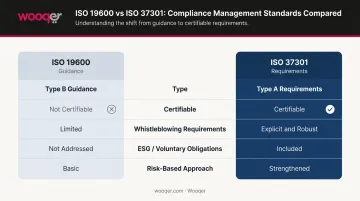
Organizations already following ISO 19600 will find the core framework largely intact — the transition is a targeted upgrade, not a ground-up rebuild.
Key Pillars of ISO 37301: What the Standard Requires
ISO 37301 is organised around seven operative clauses — Context, Leadership, Planning, Support, Operations, Performance Evaluation, and Improvement — each numbered 4 through 10 in line with ISO's High-Level Structure (HLS). Organizations already certified under ISO 9001, ISO 27001, or ISO 14001 can integrate ISO 37301 without rebuilding their entire management system from scratch.
Leadership, Governance, and Compliance Culture
Top management must visibly demonstrate commitment to the CMS — not just sign off on it. This means:
- Appointing a dedicated compliance function or officer with adequate authority
- Allocating sufficient resources (people, budget, technology) to operate the CMS
- Integrating compliance objectives into the broader business strategy
- Defining and communicating compliance responsibilities across all functions
The standard is explicit: leadership commitment is a structural requirement, not a governance formality. Compliance accountability must be embedded in job descriptions and performance reviews — built into how the organization operates, not bolted on as a parallel activity.
Risk-Based Approach and Compliance Obligations
Under ISO 37301, organizations must identify their full universe of compliance obligations and conduct ongoing risk assessments to evaluate where non-compliance is most likely and most consequential.
The RBI's Annual Report 2024-25 reported ₹54.78 crore in penalties across 353 regulated entities — a direct consequence of fragmented, unstructured compliance programs.
The standard requires a compliance register (sometimes called an obligations register): a centralized, living document that maps every obligation to:
- A responsible owner and relevant business unit
- Applicable controls and monitoring mechanisms
- A review frequency
This register must stay current. Regulatory changes, market expansions, and M&A activity can all introduce new obligations overnight. Waiting for the next audit cycle to update it defeats the purpose.
Whistleblowing, Speak-Up Mechanisms, and Non-Retaliation
ISO 37301 introduced a far more rigorous speak-up framework than its predecessor ISO 19600, making confidential reporting a formal requirement rather than a recommendation. The standard requires organizations to:
- Implement accessible, confidential, and anonymous reporting mechanisms
- Conduct timely and impartial investigations of all reports
- Document responses and corrective actions taken
- Maintain strict anti-retaliation controls that protect reporters
ISO 37002:2021 — the dedicated whistleblowing management systems standard — operates as a natural companion framework here, providing detailed guidance on designing trust-based speak-up programs.
The Four Stages of Compliance Management Under ISO 37301
ISO 37301 is built on the Plan-Do-Check-Act (PDCA) cycle — the same continuous improvement methodology used across ISO 9001 (quality) and ISO 14001 (environment). Compliance management under this standard is not a one-time project; it is an ongoing cycle.
Here is how each stage translates in practice:
- Plan — Identify all compliance obligations, assess non-compliance risks, set compliance objectives, and design the CMS structure and controls
- Do — Implement policies, procedures, and training; embed compliance responsibilities into roles across the organization; deploy operational controls
- Check — Monitor and measure CMS performance through internal audits, incident reviews, KPI tracking, and formal management reviews
- Act — Analyze findings, identify non-conformities, implement corrective actions, and improve the CMS based on evidence
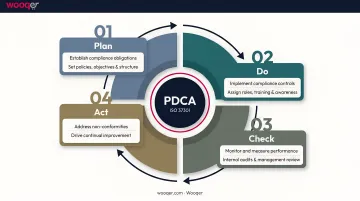
The Act stage is where most organizations underperform. Fixing an isolated incident is straightforward. Tracing it back to a systemic root cause takes structured analysis — and the payoff is substantial. McKinsey's life sciences work found that organizations using analytics-driven remediation reduced process deviations by more than 65%, which illustrates what disciplined root-cause work delivers at scale.
Effective Act-stage work requires hard data: audit trends, KPI movements, and recurrence rates. Organizations that review these metrics on a defined cadence — not just after incidents — are far better positioned to update their CMS before the next failure occurs.
ISO 37301 Certification: Process and What to Expect
ISO 37301 certification is voluntary. ISO itself does not certify organizations — certification is performed by accredited external bodies such as BSI, LRQA, TÜV SÜD, and SGS.
Why Certify?
- External validation of your CMS's design and operational effectiveness
- Increased confidence from regulators, investors, and procurement teams
- A competitive edge in tenders where compliance credentials are evaluated
These advantages are increasingly relevant in India, where regulatory expectations around formal compliance programs are tightening across sectors.
The RBI's 2020 circular on compliance functions and Chief Compliance Officers set clear expectations for structured, independent compliance programs in banking. India's revised Schedule M GMP guidelines (notified December 2023) introduced stronger formal compliance-system requirements for pharma manufacturers. Government procurement on the GeM platform also references ISO certifications in bid evaluation criteria.
The Certification Journey
| Stage | What Happens |
|---|---|
| Optional gap analysis | Identify gaps before the formal process begins — useful for first-timers |
| Stage 1 audit | Document review and readiness assessment by the accreditation body |
| Stage 2 audit | Auditors evaluate documentation, interview staff, and assess the CMS in practice |
| Certification decision | Certificate issued, or corrective actions required first |
| Surveillance audits | Annual (or more frequent) audits to verify ongoing conformance |
| Recertification | Full recertification cycle every three years |
How to Build and Implement an ISO 37301-Compliant CMS
The gap between understanding ISO 37301's requirements and putting them into practice is where most organizations struggle — especially those managing compliance across multiple locations, business units, or third-party relationships.
Centralize and Map Your Compliance Obligations
The first practical step is building a compliance register that consolidates all applicable regulations, standards, contractual obligations, and internal policies into a single source of truth. Each obligation needs:
- A named owner and relevant business function
- Applicable controls and monitoring mechanisms
- A defined review frequency
This cannot be a static spreadsheet. Regulations evolve, businesses expand, and acquisitions bring new obligations. The register must be treated as a living document with a governance process for updates.
Embed Accountability and Build Competence
ISO 37301 requires competence assessments for all personnel with compliance responsibilities. In practice, this means:
- Integrating compliance KPIs into performance reviews
- Conducting role-specific training (not generic annual e-learning)
- Assessing compliance competence during onboarding, not after
ISO 37303:2025 — the companion guidance standard for competence management — provides a practical framework for structuring these assessments.
Use Technology to Operationalize Monitoring and Reporting
Managing compliance across multiple sites, departments, or geographies with spreadsheets and email chains is not just inefficient: it creates blind spots that regulators and auditors find quickly.
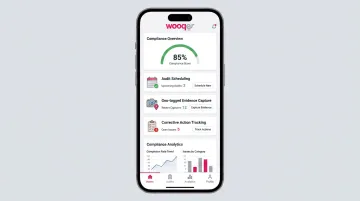
Wooqer's mobile-first compliance platform supports several ISO 37301-relevant workflows directly:
- Schedules recurring audits with calendar-based cycles and automated notifications
- Captures geo-tagged evidence with GPS verification confirming audits ran at the correct location
- Tracks corrective actions from finding to closure, linked directly to audit results
- Generates auto-formatted PDF reports and trend analytics dashboards for management review
- Assigns compliance responsibilities to specific individuals via role-based access, with completion tracking
For regulated industries in India, Wooqer's WorkApps are already deployed at scale. Axis Bank uses the platform across 4,500+ branches, achieving a 99% compliance rate and a 60% reduction in audit operation costs. Apollo Pharmacy runs pharmaceutical compliance audits across 5,000+ locations with zero major compliance violations.
Conduct Internal Audits and Management Reviews Regularly
ISO 37301 requires both periodic internal audits and formal management reviews. Management reviews serve as the structured checkpoint where compliance data gets translated into decisions. They should cover:
- Internal audit findings and trends
- Changes to compliance obligations
- Stakeholder and regulator feedback
- Risk reassessments
- CMS effectiveness metrics
Document these reviews. They feed directly into the Act stage of the PDCA cycle, and without that documentation, the continuous improvement loop breaks. Organizations that treat management reviews as a formality — rather than a genuine decision-making input — are the same ones that struggle to demonstrate CMS effectiveness when regulators come knocking.
ISO 37301 vs. Related ISO Standards: Key Comparisons
| Standard | Scope | Certifiable | Relationship to ISO 37301 |
|---|---|---|---|
| ISO 37301 | Enterprise-wide compliance management | Yes (Type A) | Core CMS standard |
| ISO 37001 | Anti-bribery and anti-corruption only | Yes | Narrower module within ISO 37301 |
| ISO 37002 | Whistleblowing management systems | No (guidance) | Supports ISO 37301's speak-up requirements |
| ISO 31000 | Risk management principles and guidelines | No | Can inform compliance risk thinking; not a CMS |
| ISO 22301 | Business continuity management systems | Yes | Separate standard; not a compliance framework |
| ISO 9001 / 14001 / 27001 | Quality, environment, information security | Yes | Share HLS structure; integrate cleanly with ISO 37301 |
ISO 37301 vs. ISO 37001 is the distinction most organizations get wrong. ISO 37301 covers the full spectrum of compliance obligations — regulatory, contractual, ESG, and ethical. ISO 37001 is a targeted module focused exclusively on anti-bribery and anti-corruption. Because both standards share the same HLS structure, organizations can implement ISO 37001 as a specific program within a broader ISO 37301 CMS without any structural conflict.
ISO 31000 and ISO 22301 are frequently confused with compliance management standards, but neither qualifies as one. ISO 31000 provides risk management principles (non-certifiable); ISO 22301 covers business continuity (certifiable but narrowly scoped). Understanding this separation matters when scoping your CMS — ISO 37301 is the appropriate framework for compliance governance specifically.
Frequently Asked Questions
Which ISO standard covers a compliance management system?
ISO 37301:2021 is the primary international standard for compliance management systems, having replaced ISO 19600 in April 2021. It is a certifiable Type A standard applicable to any organization, regardless of size or sector.
What are the four stages of compliance management?
The four stages follow the PDCA cycle: Plan (identify obligations and design controls), Do (implement policies and training), Check (monitor and audit performance), and Act (address gaps and improve the CMS).
What is the difference between ISO 37001 and ISO 37301?
ISO 37301 covers the full spectrum of compliance management across all types of obligations. ISO 37001 is a specialized standard focused solely on anti-bribery and anti-corruption programs. Both share the same HLS structure, so organizations can run them as a combined system without duplicating documentation or controls.
What is the difference between ISO 31000 and ISO 22301?
ISO 31000 provides principles and guidelines for enterprise risk management — it is not certifiable. ISO 22301 is a certifiable standard specifically for Business Continuity Management Systems. Neither is a compliance management standard; that role belongs to ISO 37301.
Is ISO 37301 certification mandatory?
Certification is voluntary. That said, organizations in regulated sectors such as banking, pharma, logistics, and government contracting face increasing pressure from regulators and clients to demonstrate a structured, verified compliance framework.
How long does ISO 37301 certification last?
Certificates are valid for three years. Annual surveillance audits by the accreditation body verify ongoing conformance, after which organizations must pursue recertification to remain certified.
Building a compliance management system that holds up under ISO 37301 scrutiny requires more than documentation — it requires real-time evidence across every location. Book a Demo to see how Wooqer operationalizes compliance monitoring at scale, or Try Wooqer and see how digital audit trails and corrective action tracking work in practice.