Introduction
Running a retail operation across multiple store locations is complex. Each location has its own staffing rhythm, foot traffic patterns, seasonal peaks, and compliance requirements — and coordinating all of that manually creates compounding operational risk.
Manual scheduling spreadsheets, paper attendance registers, and disconnected HR systems simply cannot keep pace. Shift gaps go unfilled. Overtime accumulates unnoticed. Compliance violations slip through. When managers spend hours each week on administrative tasks instead of the floor, the impact reaches beyond efficiency — it reaches your staff.
According to McKinsey's 2024 research on frontline retail, 44% of frontline retail employees are actively considering leaving their jobs. Poor scheduling and lack of operational transparency directly worsen that number.
This guide breaks down what retail workforce management software does, which features move the needle, and how to evaluate platforms for a multi-location retail operation.
Key Takeaways
- Retail WFM software automates scheduling, attendance, compliance, and workforce tracking for frontline store teams
- It directly addresses absenteeism, seasonal demand spikes, multi-location coordination, and labor law compliance
- Core features to look for: demand forecasting, shift scheduling, GPS attendance, real-time dashboards, and mobile self-service
- Stronger platforms also cover task management, SOP execution, and store-level audits — not just headcount
- The right fit depends on your store count, workforce complexity, and how much of store operations you want to digitize
What Is Retail Workforce Management Software?
Gartner defines retail workforce management applications as solutions that help retailers manage the "operational deployment and optimization of the in-store retail workforce" — improving store manager and associate effectiveness across unified retail commerce execution.
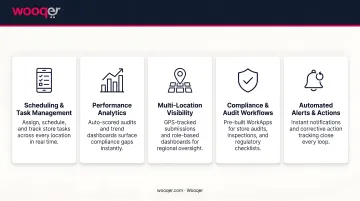
In practice, this means a suite of digital tools that handle:
- Labor forecasting — predicting how many staff are needed, when, and in which roles
- Shift scheduling — building and publishing optimised rosters automatically
- Time and attendance — tracking clock-ins, absences, and hours worked accurately
- Compliance management — enforcing labor law rules within schedules
- Performance visibility — giving managers real-time data on coverage, productivity, and gaps
How Retail WFM Differs from General HR Software
General HRMS platforms manage employee records, payroll, and benefits. Retail WFM is built for day-to-day operational deployment — shift-based teams, variable foot traffic, seasonal demand surges, and workforces that mix full-time, part-time, and contractual employees.
India's retail sector illustrates this complexity directly. IBEF reports that retail accounts for over 10% of India's GDP and employs 35+ million people — a largely deskless frontline workforce that traditional enterprise software was never designed to manage.
That scale is exactly why more advanced platforms have expanded beyond scheduling and attendance. Leading retail WFM solutions now incorporate:
- Task management — assigning and tracking in-store SOPs and daily checklists
- Store audits — digital compliance checks with photo evidence and auto-scoring
- Operational execution — closing the loop between what's planned and what actually happens on the floor
Key Retail Staffing Challenges That WFM Software Solves
High Employee Turnover
Retail consistently ranks among the highest-attrition industries. McKinsey reports that annual turnover among frontline retail workers has been at least 60% for an extended period, and that 72% of workers who left retail in the past three years left the industry entirely.
Losing a single frontline associate costs a retailer roughly ₹8,30,000 on average when accounting for recruitment, onboarding, and lost productivity. WFM software addresses the turnover cycle by:
- Identifying attrition patterns through workforce analytics before they escalate
- Improving schedule transparency so employees understand their hours in advance
- Enabling self-service shift swaps that give associates more control
Last-Minute Absenteeism and Shift Gaps
Unplanned absences are one of the most disruptive daily operational problems in retail. Without automated coverage tools, managers spend significant time making calls and rearranging rosters manually.
WFM platforms handle this through:
- Automated absence alerts that notify managers the moment a shift gap appears
- On-call staff notification workflows that reach available cover quickly
- Digital shift-swap tools that let associates resolve gaps themselves
This cuts resolution time significantly and reduces the coordination burden on store managers.
Seasonal and Peak-Period Staffing
India's festive season creates acute staffing pressure. Economic Times reported that temporary staff demand spiked 15–20% year-on-year ahead of Diwali 2024, with most of the surge concentrated in a three-week window.
WFM software uses historical sales data and footfall patterns to forecast these spikes in advance — preventing both panic-hiring and costly overstaffing during slow periods.
Labor Law Compliance
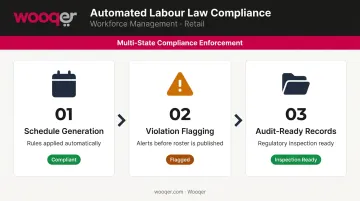
Multi-state retailers must navigate jurisdiction-specific requirements. India's state Shops and Establishments Acts set daily working hour limits and mandatory rest intervals — the Telangana Act, for example, prohibits requiring employees to work more than five hours without a rest break. The central Four Labor Codes framework adds overtime payment obligations.
WFM software enforces these rules automatically within schedule generation, flags potential violations before rosters are published, and maintains audit-ready records for regulatory inspection.
Managing a Multi-Location, Mixed-Contract Workforce
Spreadsheets break down quickly when you're coordinating full-time, part-time, and contractual employees across dozens or hundreds of stores — each with different skill requirements and shift patterns.
Centralized scheduling with role-based access and skill-matching ensures each location is staffed correctly for its specific needs, not just filled to headcount.
Must-Have Features of Retail Workforce Management Software
AI-Driven Demand Forecasting and Scheduling
The software should use historical sales data, seasonal trends, and foot traffic patterns to predict staffing needs and generate optimised schedules — rather than leaving managers to guess. Gartner's 2024 Market Guide for Retail WFM confirms that retailers are actively investing in AI-enabled scheduling to deploy existing workers more effectively, with AI-powered skills management emerging as the next frontier.
A Forrester TEI study modelling a composite retail organization with 10,000 employees across 500 locations found that AI-assisted scheduling saved store managers 5 hours per week, generating $6.1 million in scheduling optimization benefits over three years. This reflects one modelled scenario, not a guaranteed outcome — though productivity gains from AI scheduling appear consistently across deployments.
GPS-Based Time and Attendance Tracking
Manual timesheets create reconciliation problems: missed punches, manual corrections, and overtime leakage compound quietly into significant payroll inaccuracy.
Mobile clock-in/out with GPS verification addresses this for deskless retail workers. Location-aware attendance confirms that staff are physically present at the correct store, which matters when managers oversee distributed locations they cannot personally visit.
Key capabilities to look for in this area:
- GPS-verified clock-in tied to specific store locations
- Automated overtime alerts before thresholds are breached
- Payroll system integration to reduce manual reconciliation
Platforms like Wooqer include GPS tracking within their WorkApps specifically to provide this location-level verification across multi-store networks.
Real-Time Visibility and Reporting Dashboards
Managers need live, store-level visibility — not weekly reports that arrive too late to act on. Core dashboard requirements include:
- Current shift coverage vs. planned headcount
- Absent employees and unfilled shifts
- Overtime accumulation alerts by location
- KPIs including sales per labor hour and task completion rates
- Aggregated compliance scores across the store network
Spencer's Retail, operating 200+ locations on Wooqer, achieved 95% audit compliance (up from 60%) with issue resolution time dropping from two weeks to three days — driven largely by this type of real-time operational visibility.
Mobile-First Employee Self-Service
Frontline retail workers do not sit at desks. A mobile app through which associates can view schedules, request time off, swap shifts, and receive notifications is the baseline for meaningful adoption. Without it, compliance rates drop and managers absorb the administrative burden instead.
Wooqer's mobile-first WorkApps, for example, support offline capability so store teams can complete tasks and checklists even without reliable connectivity, with data syncing when the connection restores.
Task Management, SOP Compliance, and Store Audits
This is where modern retail platforms go further than traditional WFM. The strongest solutions combine workforce scheduling with operational execution — covering:
- Digital store opening and closing checklists standardized across every location
- Visual merchandising audit workflows with photo capture and AI scoring
- Planogram compliance verification against headquarters guidelines
- Corrective action tracking with automated escalation when issues are not resolved
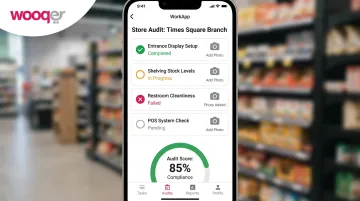
Wooqer's marketplace offers 55+ pre-built retail WorkApps — including Store Audit, Visual Merchandising Audit, Planogram Compliance, and Customer Service Audit — all deployable across hundreds of stores from a single platform. Lifestyle Stores achieved an 85% faster VM rollout across 80+ stores using these tools, with VM compliance improving from 65% to 95%.
Key Benefits of Retail WFM Software
Labor Cost Control
Automated scheduling tied to demand forecasts prevents the two most common cost leakages: overstaffing during slow periods and unplanned overtime during peaks. Accurate time tracking reduces the payroll reconciliation effort and catches errors before payroll runs.
A Forrester TEI study for a composite retail organization reported $287,700 USD in overtime savings over three years, with a payback period under six months for the UKG implementation modelled. These are commissioned studies with composite organizations — but the underlying mechanisms apply regardless of vendor.
Reduced Attrition
Schedule transparency and self-service access directly affect how associates feel about their employer. Gartner notes that well-configured retail WFM solutions can reduce avoidable attrition by building flexibility and associate experience accelerators into scheduling.
When associates feel a schedule works for them, they stay longer. Given that replacing a single frontline associate costs approximately ₹8,30,000, even a modest reduction in turnover generates real cost savings — particularly for retailers managing hundreds of store employees across multiple locations.
Consistent Operational Standards at Scale
WFM software enforces the same scheduling policies, compliance rules, and task standards across every store — regardless of location, store size, or local management. This is where multi-location Indian retailers gain the most: consistent execution without relying on individual store managers to remember every procedure.
Wooqer's platform achieves 98% compliance rates across 50,000+ stores managed, driven by standardized digital workflows that every location follows identically.
Data-Driven Operations Management
Centralized analytics give retail heads and operations managers a clear view of:
- Performance gaps between top-performing and underperforming stores
- Attendance patterns and skill shortages by location
- Compliance trends across regions and formats
- Task completion rates and audit scores aggregated in real time
When you're managing operations across multiple cities or states, acting on live data rather than week-old reports is the difference between catching a problem early and inheriting a larger one.
How to Choose the Right Retail Workforce Management Software
Step 1 — Define Your Workforce Complexity and Scale
Before evaluating any platform, assess:
- Number of store locations
- Total employee headcount and breakdown (full-time, part-time, contractual)
- Shift patterns and whether they vary significantly by location or season
- Current pain points: absenteeism, compliance, visibility, or all three
A single-format retailer with 15 stores has different requirements from a multi-format chain with 300 locations across several states. Scale and complexity determine whether a basic scheduling tool or a full-featured WFM platform is the right investment.
Step 2 — Prioritize Features Against Your Biggest Pain Points
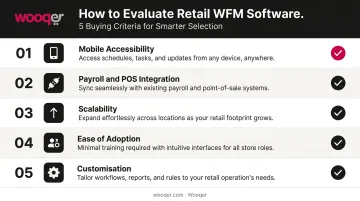
Identify your top two or three operational challenges and evaluate software specifically against those — not a generic feature checklist. Key buying criteria to assess:
- Mobile accessibility — can frontline staff actually use it on their phones?
- Payroll and POS integration — does it connect with systems you already run?
- Scalability — will it handle growth from 50 stores to 500?
- Ease of adoption — what is the realistic onboarding timeline for store teams?
- Customization — can you configure it to your specific workflows without long implementation cycles?
Step 3 — Look Beyond Scheduling to Full Operational Management
The most practical retail platforms today combine workforce scheduling with operational execution in one environment. When evaluating options, consider whether the platform can also handle:
- Task management and corrective action tracking
- Compliance audits and visual merchandising workflows
- GPS-based attendance verification
- Real-time dashboards accessible across store and regional teams
This matters in practice. Spencer's Retail deployed Wooqer — a no-code platform with 55+ ready-to-use retail WorkApps — across 200+ stores in six weeks, with measurable improvements in compliance rates and issue resolution speed. That kind of rollout is only possible when the platform is built for multi-location retail from the start, not adapted from a generic HR tool.
Frequently Asked Questions
What is workforce management (WFM) in retail?
Retail WFM is the process of planning, scheduling, monitoring, and optimising a store's frontline workforce to ensure the right staff are available at the right times. It covers scheduling, attendance tracking, labor compliance, and performance management across every store location.
What are the must-have features of retail workforce management software?
Demand forecasting, automated shift scheduling, GPS-based time and attendance, real-time dashboards, mobile employee self-service, and compliance enforcement are the core requirements. Leading platforms add task management, store audits, and SOP execution on top of these foundations.
How does retail WFM software help reduce labor costs?
By aligning staffing levels to actual demand forecasts, WFM software prevents overstaffing during quiet periods and unplanned overtime during peaks. Automated time tracking also reduces payroll errors and eliminates the expense of last-minute agency cover.
What is the difference between WFM software and HRMS?
WFM software manages day-to-day workforce operations — scheduling, attendance, and compliance. HRMS handles core HR functions like employee records, benefits, and payroll administration. Many retailers use both, or choose a platform that integrates operational execution with HR data in one system.
Can retail WFM software support multi-location store operations?
Modern retail WFM platforms are designed specifically for multi-location management, with centralized scheduling, real-time visibility across all stores, consistent policy enforcement, and role-based access so each role sees only what's relevant to them.
Whether you're tackling shift gaps, compliance gaps, or visibility gaps across your store network, Book a Demo to see how Wooqer supports retail workforce and operations management end to end, or Try Wooqer and get your first store audit running today.