The stakes are real. OSHA's 2025 penalty schedule sets maximum fines at $16,550 per serious violation and $165,514 for willful or repeated violations. Meanwhile, the National Safety Council estimates US work injury costs at $181.4 billion in 2024 — with each medically consulted injury averaging $48,000. EHS software has moved from a compliance checkbox to an operational risk control system.
Choosing the wrong platform leads to audit failures, open corrective actions, and fragmented data across sites. The right one gives field teams a tool they'll actually use and gives leaders real-time visibility to act before incidents escalate.
This guide breaks down the best EHS management software for 2026, with honest evaluations of each platform's strengths and the buyer criteria that matter most.
Key Takeaways
- EHS management software centralizes incident reporting, audits, compliance tracking, and corrective actions on a single platform — replacing paper-based processes.
- The best options for 2026 are mobile-first, cloud-based platforms that support real-time data capture across multiple locations.
- Key selection criteria: ease of deployment, offline capability, corrective action tracking, customizability, and frontline adoption.
- Top picks include Wooqer, SafetyCulture, Intelex, VelocityEHS, and Benchmark Gensuite — each suited to different operational profiles.
- Multi-site teams in India can deploy Wooqer's AI-powered, no-code platform in minutes — no IT involvement required.
What Is EHS Management Software and Why Does It Matter in 2026?
EHS management software is a digital platform that centralizes environment, health, and safety operations — covering incident reporting, risk assessments, compliance tracking, audits, corrective actions, and performance analytics in one place, replacing spreadsheets and paper-based processes.
The market reflects growing urgency. Verdantix values the global EHS software market at $1.9 billion in 2023, forecasting $4.5 billion by 2029 at a 14.6% CAGR — driven by demand for mobile-first solutions, AI-powered analytics, and cross-location compliance visibility.
Why 2026 Is a Meaningful Inflection Point
Three specific pressures are reshaping how organizations approach EHS in 2026:
- Regulatory digitization — In India, the Occupational Safety, Health and Working Conditions Code, 2020 consolidates multiple labor laws and supports electronic registration, electronic returns, and web-based inspections. Multi-site organizations in India are facing structured compliance requirements that paper systems simply can't meet reliably.
- Frontline adoption gaps — The American Society of Safety Professionals reports that many EHS programs lack meaningful insight into how frontline workers actually interact with their environment. Mobile apps with offline capability and fast issue capture directly address this.
- AI-driven risk intelligence — Leading platforms are moving beyond reactive incident tracking toward predictive analytics that surface risk patterns before incidents occur.
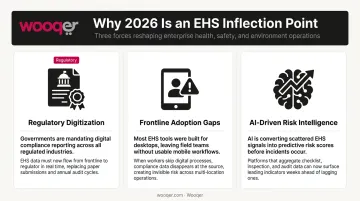
These pressures mean a platform's value is no longer measured by its feature count — it's measured by how quickly it closes the gap between a hazard occurring and a corrective action being owned. The sections below evaluate the best options with that standard in mind.
Best EHS Management Software for 2026
These platforms were evaluated on mobile-first design, customization ease, incident and audit management depth, reporting capabilities, multi-site scalability, and industry suitability across manufacturing, retail, logistics, energy, and pharma.
Wooqer
Wooqer is an AI-powered, mobile-first operations platform built for organizations digitizing EHS audits, inspections, compliance workflows, and corrective actions across multiple locations. Its marketplace includes 37+ Safety & Compliance WorkApps used by over 100,000 users, spanning:
- Incident reporting and shop-floor safety audits
- PPE compliance and hazard identification
- Chemical safety, fire safety, and more
WorkApps configure and launch in minutes through a drag-and-drop, no-code interface — no IT involvement required. The AI-powered SensEye technology enables photo capture with annotations, GPS-tagged evidence, auto-scoring, and trend analytics, giving EHS teams root cause analysis capability across every site. Offline capability makes it a practical choice for field teams in remote or low-connectivity environments.
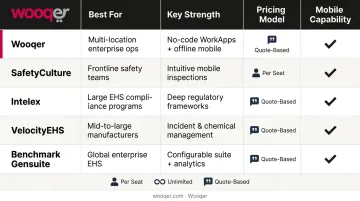
The platform's unlimited-user pricing model eliminates the per-seat friction common in enterprise EHS tools — organizations can scale to thousands of frontline users without increasing licensing costs.
| Attribute | Details |
|---|---|
| Best For | Multi-site organizations in India across manufacturing, retail, logistics, pharma, and energy seeking a mobile-first, rapidly deployable EHS platform |
| Key Features | Customizable WorkApps, AI-powered SensEye, GPS and photo capture, corrective action tracking, auto-scoring, instant PDF reports, role-based access, offline mode, calendar scheduling |
| Deployment & Access | Cloud-based, works on any device (iOS and Android), ready in minutes, supports unlimited team members, no per-seat licensing |
SafetyCulture (iAuditor)
SafetyCulture is a globally recognized mobile-first EHS and inspection platform used by over 76,000 organizations across construction, retail, logistics, and manufacturing. It's built around turning paper-based inspection and audit workflows into fast mobile experiences.
An extensive template library of 1,000+ pre-built checklists, real-time reporting, and strong frontline usability make SafetyCulture easy to roll out quickly. It's particularly well-suited for teams prioritizing speed of digital inspection adoption across distributed sites — iAuditor reports over 50,000 uses per day in 85+ countries (vendor-reported).
| Attribute | Details |
|---|---|
| Best For | Organizations needing fast digitization of inspections and checklists across multiple sites with high frontline user adoption |
| Key Features | Mobile inspections, pre-built templates, issue reporting, analytics dashboard, training tools, third-party integrations |
| Deployment & Access | Cloud-based SaaS, iOS and Android; Free plan for up to 10 users; Premium at $24/seat/month (billed annually); Enterprise pricing on request |
Intelex (Hexagon)
Intelex, now part of Hexagon, is an enterprise-grade EHSQ platform trusted by over 1,400 organizations for managing complex compliance workflows, incident tracking, audit management, and sustainability reporting at scale.
Deep workflow configurability is its core strength — teams can tailor forms, dashboards, and reporting to reflect complex organizational hierarchies. Its unified EHSQ architecture suits organizations where quality management and safety compliance must run from a single platform. RESTful API support enables integration with existing enterprise systems.
| Attribute | Details |
|---|---|
| Best For | Large enterprises with complex EHS and quality management needs requiring high configurability and global regulatory alignment |
| Key Features | Configurable EHSQ workflows, incident management, audit automation, compliance tracking, advanced analytics, API integrations |
| Deployment & Access | Cloud-based enterprise SaaS; Safety Essentials starts at $44 USD/user/month (minimum 25 users, billed annually); Advanced and Enterprise tiers require quote |
VelocityEHS
VelocityEHS delivers broad EHS coverage — incident management, risk assessments, chemical management, ergonomics, and operational risk — through a single connected platform called the Accelerate Platform.
VelocityEHS stands out on risk-domain depth. Its VelocityAI intelligence layer analyzes incident data, safety data sheets, ergonomic video data, and more to surface risk signals earlier. Verdantix's 2026 report confirms AI application across safety, operational, ergonomic, chemical, and contractor risk domains — a broad capability set for organizations running complex multi-domain EHS programs.
| Attribute | Details |
|---|---|
| Best For | Mid-market to enterprise organizations seeking scalable, multi-domain EHS coverage with strong mobile access and AI-assisted risk analytics |
| Key Features | Incident management, risk assessments, audits, chemical management, ergonomics, training, mobile access, AI-driven analytics |
| Deployment & Access | Cloud-based SaaS; modular pricing available — contact vendor for details |
Benchmark Gensuite
Benchmark Gensuite is a modular, cloud-based EHS and ESG platform built on a single architecture, covering incident management, audits, corrective actions, training, compliance tracking, and sustainability reporting.
Its app-based, modular structure lets organizations deploy only what they need and expand as programs mature — useful for teams building out EHS capabilities over time. The all-access subscriber model eliminates user-limit pricing concerns. Benchmark reports a 4–6 month implementation timeline with 100% on-time delivery (vendor-reported). Industry coverage spans aerospace, chemicals, construction, energy, healthcare, logistics, manufacturing, oil and gas, pharma, retail, and utilities.
| Attribute | Details |
|---|---|
| Best For | Multi-site organizations seeking a flexible, modular EHS platform with fast time-to-value and scalability over time |
| Key Features | Modular EHS apps, incident tracking, audits and inspections, corrective actions, ESG reporting, compliance tools, mobile-first design |
| Deployment & Access | Cloud-based SaaS; all-access/no-user-limit model; contact vendor for pricing |
How We Chose the Best EHS Management Software
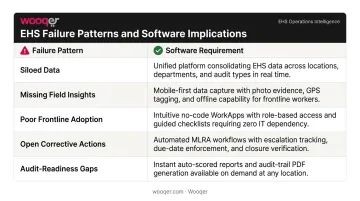
These platforms were assessed against the most common EHS management failures — not just feature checklists.
The Failure Modes That Drive Selection Criteria
| Failure Pattern | Software Implication |
|---|---|
| Siloed safety data across sites | Require unified dashboards and cross-site reporting |
| Missing data-driven insight into field behavior | Weight analytics, trend detection, and auto-scoring |
| Poor frontline adoption of digital tools | Require mobile-first forms, offline use, and fast issue capture |
| Open corrective actions without accountability | Prioritize corrective action closure, owner assignment, and deadline tracking |
| Audit-readiness gaps | Require instant report generation and evidence attachment |
Key Evaluation Criteria
- Mobile-first design and offline functionality — non-negotiable for field teams
- Ease of customization without IT dependency — determines real deployment speed
- Incident and corrective action management depth — separates genuine EHS tools from basic checklists
- Real-time visibility across multiple locations — dashboards, alerts, and trend analytics at regional and enterprise levels
- Industry fit — pre-built workflows reduce configuration time and improve frontline adoption
- Scalability — pricing model and architecture must support growth without friction
The best EHS software is not necessarily the most feature-rich. It's the one frontline teams actually use — consistently enough to generate reliable data and give leaders the visibility to act before incidents occur. A platform that takes six months to implement, or requires heavy IT involvement just to get started, often costs more in downtime than it saves in compliance.
Conclusion
Choosing EHS management software in 2026 means matching the platform to your operational reality — the size of your field teams, the number of sites, your industry's specific risk profile, and how quickly you need to go live.
When evaluating options, look beyond licensing fees. The factors that determine real-world fit include:
- Scalability: Can it grow with new sites without per-seat pricing penalties?
- Mobile readiness: Will frontline teams actually use it in the field?
- Deployment complexity: A powerful platform that takes months to configure may not outperform a leaner tool that's live next week.
For multi-location operations in India looking to digitize EHS audits, compliance workflows, and corrective actions, Wooqer is worth a close look. It deploys in minutes, works on any device, supports unlimited team members, and includes pre-built WorkApps built for audits, inspections, and real-time reporting. Explore Wooqer's EHS WorkApps or request a demo to see it in action.
Frequently Asked Questions
What is EHS management software?
EHS management software is a digital platform organizations use to manage environmental, health, and safety processes — including incident reporting, compliance tracking, audits, risk assessments, and corrective actions. It replaces manual and paper-based systems with centralized, real-time workflows accessible from any device.
What is the difference between EHS and HSE?
EHS (Environmental, Health, and Safety) and HSE (Health, Safety, and Environment) refer to the same discipline. The difference is purely terminology: EHS is more common in North America, while HSE is standard in the UK, Europe, and the oil and gas sector globally.
What is ERP integration in EHS management?
ERP integration connects EHS software with core business systems like SAP or Oracleso data flows consistently across the organization — for example, HR records feed into employee incident tracking, and operations data populates environmental reports. This keeps information connected across departments and improves compliance accuracy.
What are the key features to look for in EHS software?
Prioritize these capabilities:
- Mobile and offline access for field teams
- Incident reporting and corrective action management
- Customizable audit and inspection checklists
- Real-time analytics and dashboards
- Regulatory compliance tracking
- Instant report generation across multiple sites
How much does EHS management software cost?
Pricing varies significantly. SafetyCulture offers a free plan (up to 10 users) and a Premium tier at $24/seat/month. Intelex's Safety Essentials starts at $44 USD/user/month (minimum 25 users). VelocityEHS and Benchmark Gensuite require vendor contact for pricing. Wooqer uses an unlimited-user model with no per-seat fees — contact their team for a quote.
Can EHS management software work for small and mid-sized businesses?
Yes. Modern EHS platforms are designed to scale — modular and app-based structures let smaller teams start with core features like audits and incident reporting, then expand over time. Mobile-first platforms with fast deployment, such as Wooqer, are well-suited for SMBs that need full capability without long setup timelines.
If your EHS program needs real-time visibility across field locations without months of implementation, Book a Demo to see Wooqer's safety and compliance WorkApps in action, or Try Wooqer and get your first EHS audit running on any mobile device today.