Introduction
According to WHO, foodborne diseases cause an estimated 866 million illnesses and 1.52 million deaths every year worldwide, with unsafe food costing approximately US$310 billion annually in medical expenses and lost productivity. In India, FSSAI data shows that out of 170,535 food samples analyzed in FY 2024-25, over 30,000 civil cases were decided with penalties — a clear signal that non-compliance carries real consequences.
Yet for food business operators, the consequences extend well beyond fines. Inconsistent standards across locations, paper-based records that get lost or falsified, difficulty tracking corrective actions, and scrambling to produce documentation when inspectors arrive — these operational failures are just as costly as the penalties themselves.
This guide covers everything you need to build, implement, and maintain an effective Food Safety Management System (FSMS): core components, step-by-step implementation, key certifications, and practical strategies for keeping your system audit-ready.
Key Takeaways
- An FSMS is a structured framework combining PRPs, HACCP, SOPs, traceability, and documentation to control food safety hazards across the entire supply chain.
- HACCP is a component of an FSMS — not a substitute for one.
- Building an FSMS follows five steps: scope definition, hazard analysis, PRP/SOP development, team training, and ongoing monitoring.
- ISO 22000, FSSC 22000, BRCGS, and SQF are the major global certifications; FSSAI compliance is mandatory in India.
- For multi-site food businesses, digitising records and standardising procedures across locations drive the most consistent compliance outcomes.
What is a Food Safety Management System and Why Does It Matter?
An FSMS is a structured framework of policies, procedures, and controls designed to identify, prevent, and reduce food safety hazards across the entire supply chain — from raw material sourcing through to the end consumer. FSSAI defines it as interrelated programs, plans, policies, procedures, controls, roles, documents, and records that ensure food does not cause adverse health effects.
The underlying principle is farm to fork — meaning every stage of handling, processing, storage, and distribution falls within scope. This applies across food business types:
- Restaurants and quick service restaurants (QSRs)
- Food manufacturers and processors
- Catering operations
- Retail food stores
- Multi-location chains
Understanding who needs an FSMS is only the starting point. The harder question is what it costs when businesses operate without one.
Why Businesses Can't Afford to Skip It
An FSMS directly addresses four interconnected risks:
- Regulatory compliance — FSSAI's Schedule 4 mandates a documented FSMS plan for all licensed food businesses in India, based on GMP, GHP, and HACCP principles. Internationally, ISO 22000 and the Codex General Principles of Food Hygiene set the baseline.
- Brand protection — A single contamination incident can trigger recalls, media coverage, and lasting reputational damage.
- Market access — Institutional buyers, major retailers, and export markets increasingly require GFSI-recognized certification as a minimum supplier qualification.
- Financial exposure — Recall costs, legal liability, and lost business from a single outbreak can run into crores. FSSAI enforcement actions have also led to product seizures and license suspensions that shut down operations entirely.
Core Components of an Effective FSMS
A functional FSMS has five interconnected layers. Skipping any one of them creates gaps that regulators and third-party auditors will find.
Here is what each layer covers and why it matters:
Prerequisite Programs (PRPs)
PRPs form the foundational layer: the basic environmental and operating conditions that make hazard control possible. Codex defines them as programs — including GHP, GMP, and related practices — that establish hygiene baselines before HACCP is applied.
PRPs cover:
- Sanitation standard operating procedures
- Pest control programs
- Personal hygiene policies
- Equipment maintenance schedules
- Facility design and layout controls
When PRPs are weak or inconsistently applied, upstream contamination risks reach HACCP control points already compromised.
HACCP
FDA defines HACCP as a management system that addresses food safety through analysis and control of biological, chemical, and physical hazards — from raw material production through manufacturing, distribution, and consumption.
HACCP is both a standalone methodology and the hazard-control backbone of higher-level standards like ISO 22000. Its seven principles — from hazard analysis to verification procedures — define how critical limits are set and monitored at each control point.
GMPs and SOPs
Good Manufacturing Practices set hygiene and safety standards for processing, handling, and packaging. Standard Operating Procedures translate those standards into written, step-by-step instructions that every team member can follow consistently, regardless of shift, site, or experience level.
Together, GMPs and SOPs ensure that correct practice isn't left to individual judgment. Key areas they typically govern include:
- Handwashing and personal protective equipment protocols
- Approved cleaning chemicals and contact surfaces
- Temperature controls during storage and preparation
- Product handling and cross-contamination prevention
Traceability and Recall Systems
Traceability mechanisms allow businesses to track products through the supply chain and quickly isolate contaminated goods. For multi-site operations, the ability to identify which batch, from which supplier, reached which locations within hours (not days) determines how contained an incident remains.
Documentation and Record-Keeping
Documentation is the proof layer. An FSMS without records is unverifiable. This includes:
- Temperature and monitoring logs
- Internal audit reports
- Corrective action records
- Supplier certificates
- Employee training documents
Records support root cause analysis after incidents and demonstrate compliance during regulatory inspections.
How to Build and Implement an FSMS: Step-by-Step
Step 1: Define Scope, Objectives, and Team
Start by mapping your operation — the products handled, processes involved, number of sites, and applicable regulations. Then assemble a food safety team with clear roles. At least one certified food safety professional should lead the effort. ISO 22000 specifically requires documented food safety team competency.
Step 2: Conduct a Hazard Analysis and Establish Controls
Work through each stage of food handling systematically. For each step:
- Identify hazards — biological (pathogens), chemical (allergens, cleaning agents), physical (foreign objects)
- Assess risk — likelihood and severity of harm if the hazard is not controlled
- Define CCPs — the specific points where control is essential to prevent or eliminate the hazard
- Set critical limits — the measurable thresholds (temperature, time, pH) that define safe versus unsafe
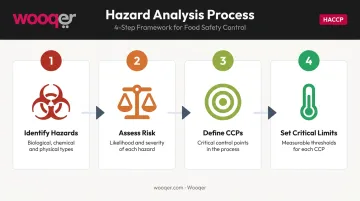
FDA's HACCP Principles and Application Guidelines provide the standard methodology for this process.
Step 3: Develop and Document PRPs and SOPs
Write, approve, and communicate every PRP and SOP before go-live. Key areas to document:
- Sanitation procedures and frequency
- Allergen control protocols
- Temperature monitoring requirements
- Supplier approval and incoming goods inspection
- Employee hygiene standards and corrective actions
Each document should specify who is responsible, how often monitoring occurs, and what to do when a deviation is found.
Step 4: Train the Team and Build a Food Safety Culture
An FSMS only works when people follow it. Effective training covers three distinct layers:
- Role-specific instruction — a kitchen hand needs different guidance than a quality manager
- Procedural reasoning — staff should understand why each step exists, not just how to perform it
- Leadership modeling — management must treat food safety as non-negotiable, not just post it on a notice board
A 2024 peer-reviewed review in Foods confirms that leadership commitment and cultural dynamics are central to effective food safety outcomes.
Step 5: Monitor, Verify, and Continuously Improve
Build an ongoing cycle of monitoring and improvement that keeps the system current:
- Internal audits (scheduled and unannounced)
- Corrective action tracking with root cause analysis
- Management reviews
- Document updates triggered by menu changes, process changes, regulatory updates, or incidents
Once this cycle is running consistently, you can assess readiness for external certification. NQA, an ISO certification body, recommends the system be fully operational for at least three months — including a completed management review and full internal audit cycle — before pursuing it.
Key FSMS Standards and Certifications to Know
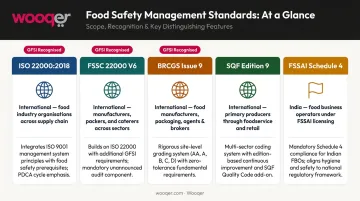
| Standard | Scope | Key Feature |
|---|---|---|
| ISO 22000:2018 | Any organization in the food chain | Integrates HACCP + management systems; globally applicable |
| FSSC 22000 V6 | Food manufacturing, packaging, catering | GFSI-recognized; builds on ISO 22000 with sector-specific requirements |
| BRCGS Issue 9 | Food manufacturing and packing | Widely required by UK and European retailers |
| SQF | Farm to retail; export supply chains | 14,000+ certified sites in 40 countries; common for US market access |
| FSSAI Schedule 4 | All licensed food businesses in India | Mandates documented FSMS based on GMP, GHP, and HACCP principles |
Certified vs. Non-Certified: What's the Difference?
A certified FSMS has been independently audited by an accredited certification body and carries formal third-party recognition. Major retailers like Walmart require GFSI-recognized certification for unlabelled or exclusive products. Failure to maintain it can result in vendor deactivation.
A non-certified in-house system can meet minimum regulatory obligations but won't satisfy institutional buyers or export market requirements. If your growth targets include larger retailers or cross-border trade, the certification path below is worth understanding.
The Certification Path
The typical process follows these steps:
- Gap assessment — identify where current practices fall short of the target standard
- FSMS development and documentation — build or formalize procedures, records, and controls
- Internal audit — validate readiness before inviting external scrutiny
- External third-party audit — conducted by an accredited certification body
- Certification issuance — formal recognition issued upon successful audit
- Annual surveillance audits — ongoing verification of continued compliance
- Three-yearly recertification — full reassessment cycle to maintain status
Each stage generates documentation that supports both regulatory inspections and customer due diligence reviews.
Best Practices for Maintaining a Compliant and Effective FSMS
Standardize Across All Locations
For multi-site food businesses, inconsistency between locations is one of the most common FSMS failure points. The solution is a single, centrally managed system applied identically at every site — with regular cross-site audits to verify adherence.
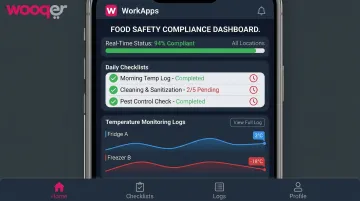
Platforms like Wooqer support this through pre-built WorkApp templates deployed across all locations simultaneously. Role-based access controls ensure only authorized staff complete or modify records, and real-time compliance dashboards give management visibility into every site's status — no chasing updates required.
Make Documentation Digital and Real-Time
Paper-based records create compounding risks: lost logs, delayed visibility, and documentation that can be falsified or simply forgotten during a busy service. When an inspector arrives, scrambling for paperwork is not an option.
Wooqer's food and beverage WorkApps replace paper with mobile-first digital workflows. Specific tools include:
- Food Safety Checklist (19K+ users, 4.9 rating) — HACCP compliance and hygiene verification
- Kitchen Hygiene Audit (15K+ users, 4.8 rating) — sanitation standards with photo evidence
- Temperature Monitoring — digital refrigerator and freezer logs with real-time tracking
- Supplier Quality Check (15K+ users, 4.8 rating) — incoming ingredient inspection
- Allergen Management — cross-contamination prevention tracking
All WorkApps generate instant PDF reports upon task completion, provide GPS-verified audit trails, support offline completion with automatic sync, and feed into trend analytics dashboards for cross-site comparison.
Results from Wooqer customers illustrate the impact: Chai Point (180+ outlets) achieved a 98% food safety compliance score and reduced quality incidents by 80%; Domino's (1,500+ stores) reached a 99% food safety compliance rate with 40% faster audits across their entire network.
Treat Corrective Actions as Learning Opportunities
When a deviation is found, fixing the immediate issue is only the first step. The corrective action process should also address why it happened — to prevent recurrence, not just resolve the symptom.
A structured corrective action process includes:
- Documenting the deviation and its immediate resolution
- Conducting root cause analysis to identify underlying factors
- Tracking actions to closure with clear ownership
- Using trend data to surface systemic weaknesses across locations
For example, a single site consistently failing temperature checks often signals a management or training gap, not just a faulty refrigerator.
Wooqer's platform includes a dedicated Corrective Action Log and Root Cause Analysis WorkApp, with automated notifications for accountability and trend analytics to surface patterns across locations.
Schedule Regular Training Refreshers and Internal Audits
Food safety knowledge degrades without reinforcement. Build a structured cadence:
- Refresher training after incidents, process changes, menu changes, or new hires
- Scheduled internal audits at regular intervals (weekly, monthly, quarterly depending on risk level)
- Unannounced audits to simulate third-party inspection conditions
Wooqer's calendar scheduling and audit WorkApps support both planned and ad-hoc inspections, with auto-scoring for objective cross-site comparison. Wooqer Academy also offers free certification programs for Producers (content creators and solution designers), Reviewers (regional and area managers), and Store Teams (frontline staff) — validated with digital badges and verifiable credentials.
Common FSMS Implementation Challenges and How to Overcome Them
Employee Resistance and Low Compliance Rates
Frontline staff often experience FSMS procedures as bureaucratic overhead, particularly when processes involve paper forms that slow down service. The fix is two-part: simplify the process and explain the rationale.
Mobile-first tools reduce friction significantly. Wooqer's WorkApp interface guides staff through tasks with photo capture, auto-scoring, and automated notifications. A compliance check takes less time than filling out a paper log, and the platform's food safety apps report 98% completion rates and 70% time savings compared to manual processes.
Practically, this means fewer skipped checks, faster close-outs, and less manager follow-up.
Maintaining Consistency Across Multiple Locations
Different site managers interpreting procedures differently is a structural problem, not a people problem. Centralising FSMS documentation in a single platform addresses this directly. Standardized digital checklists and a real-time dashboard showing compliance status across all locations close off the gaps that inconsistent interpretation creates.

Wooqer's multi-location architecture is built specifically for this: organizations managing 50,000+ locations globally use the platform to enforce identical standards, from temperature logs to hygiene audits.
Keeping the FSMS Current with Regulatory Changes
FSSAI updates its advisories, notifications, and requirements regularly. Businesses relying on static paper-based systems often fall behind — sometimes without realising it until an audit.
Two steps close this gap:
- Assign a designated FSMS owner responsible for monitoring FSSAI notifications and triggering document revisions
- Set a formal review cycle — at minimum annually, or immediately when a regulatory change is announced
Wooqer's fully customisable WorkApps support this directly: when a regulatory update requires a procedure change, the updated workflow deploys across all locations without site-level intervention. Every team works from the same current version.
Frequently Asked Questions
What is HACCP and how does it relate to an FSMS?
HACCP (Hazard Analysis and Critical Control Points) is a systematic, science-based methodology for identifying and controlling food safety hazards at critical stages of production. It is a core component of an FSMS — not a replacement for it — and forms the hazard-control backbone of standards like ISO 22000.
What are the 5 basics of food safety?
The WHO's Five Keys to Safer Food cover the fundamentals of safe handling:
- Keep clean (personal and surface hygiene)
- Separate raw and cooked foods to prevent cross-contamination
- Cook food to safe internal temperatures
- Chill food correctly to slow bacterial growth
- Use safe water and raw materials
What are the 7 steps of HACCP?
The seven HACCP principles move from analysis to control: conduct a hazard analysis, identify Critical Control Points, establish critical limits, set monitoring procedures, define corrective actions, verify the system works, and maintain records throughout. Each step builds on the last.
What are the 4 key components of an FSMS?
According to ISO 22000, the four foundational elements are: interactive communication across the food supply chain, system management (leadership and process approach), prerequisite programs (GMPs, sanitation, hygiene basics), and HACCP principles (hazard identification and control).
Is an FSMS legally required for food businesses?
Yes, in most major markets. India's FSSAI requires it under Schedule 4 for licensed businesses; the EU mandates a permanent HACCP-based procedure under Regulation (EC) No 852/2004; and the US requires hazard analysis and preventive controls under 21 CFR Part 117. Even where not explicitly mandated, regulators, retailers, and institutional buyers widely expect a functioning FSMS.
What is the difference between an FSMS and HACCP?
HACCP is one tool within a larger system. It covers how hazards are identified and controlled at critical production points. An FSMS goes further — wrapping HACCP inside a full management framework that includes PRPs, documentation, training, traceability, and continuous improvement.
Building a food safety management system that works across every location — not just the ones an inspector visits — takes more than good documentation. Book a Demo to see how Wooqer helps multi-site food businesses maintain consistent compliance at scale, or Try Wooqer and get your food safety checklists running digitally today.